
Please Choose Your Language
Views: 0 Author: Site Editor Publish Time: 2026-07-25 Origin: Site


Generating high-intensity laser beams inherently produces massive thermal loads. You must manage this heat to prevent equipment failure and weld defects. Fiber laser systems operate by converting electrical energy into concentrated light, creating intense friction and heat within the oscillator and optical delivery components. Ignoring thermal management creates severe operational bottlenecks. Inadequate cooling leads to thermal lensing, reduced duty cycles, inconsistent penetration depths, and premature degradation of expensive optical components. You must decide between air-cooled and water-cooled systems based on your facility's reality. This choice aligns the cooling mechanism with your specific production volumes, ambient environments, and material requirements. Understanding when a Water Cooled Laser Welding Machine becomes mandatory saves you from catastrophic downtime and scrapped parts.
Duty Cycle Thresholds: A water cooled laser welding machine is strictly required for operations exceeding 8 hours of daily use or requiring 100% continuous duty cycles.
Environmental Limits: Facilities with ambient temperatures consistently exceeding 30°C (86°F) require water cooling to prevent system derating and thermal shutdowns.
Power and Penetration: Applications requiring high-power outputs (typically >1500W) for thick materials necessitate the superior thermal dissipation of water-cooled systems.
Trade-Off Reality: While water cooling guarantees beam stability and high-volume output, it introduces a larger equipment footprint, reduced portability, and specific chiller maintenance requirements.
Successful thermal management defines the boundary between a reliable manufacturing process and a constant maintenance headache. You achieve success when your system maintains a stable beam profile, a consistent focal length, and uninterrupted operation. To reach these criteria, you must extract waste heat at the exact rate it is generated. Heavy-duty industrial laser welding demands absolute thermal equilibrium to function correctly on the shop floor.
Fiber lasers are highly efficient compared to older technologies, but they still generate massive thermal loads. The electrical-to-optical conversion efficiency typically hovers between 30% and 40%. This means 60% to 70% of the input energy instantly becomes waste heat. You must extract this heat from both the main oscillator and the delicate welding head. If you fail to remove this thermal energy, the internal components will rapidly overheat and fail. The physics of heat transfer dictate that you need a medium capable of absorbing and moving this energy away from sensitive electronics and optics.
Poor cooling introduces the severe risk of thermal lensing. When optical components absorb excess heat, they physically expand and change their refractive index. This distortion shifts the focal point of the laser beam away from your programmed parameters. You will experience erratic weld penetration, wider heat-affected zones, and severe quality issues. Active thermal extraction prevents the lenses from warping under sustained laser power. When you push a laser source hard, the protective windows and focusing lenses take the brunt of the thermal abuse. Keeping them at a stable temperature is the only way to maintain a consistent spot size.
To understand the scale of heat generation, consider the thermal dynamics of a standard 2000W fiber laser source operating at full capacity. The system draws roughly 6000W of electrical power. Only 2000W exits as usable laser light. The remaining 4000W of energy converts directly into heat within the machine cabinet and the delivery fiber. You cannot simply blow ambient air over a heat sink to dissipate 4000W of continuous thermal energy effectively, especially in a warm factory environment.
Thermal Load Distribution in Fiber Laser Systems | |||
Component | Heat Generation Source | Cooling Requirement Level | Consequence of Overheating |
|---|---|---|---|
Pump Diodes | Electrical to optical conversion inefficiency | Extreme | Diode failure, permanent power loss |
Active Fiber | Quantum defect during photon emission | High | Beam quality degradation, fiber burning |
Collimating Optics | Absorption of scattered laser light | Moderate to High | Thermal lensing, focal shift |
Focusing Lenses | Direct beam transmission absorption | High | Erratic penetration, lens cracking |
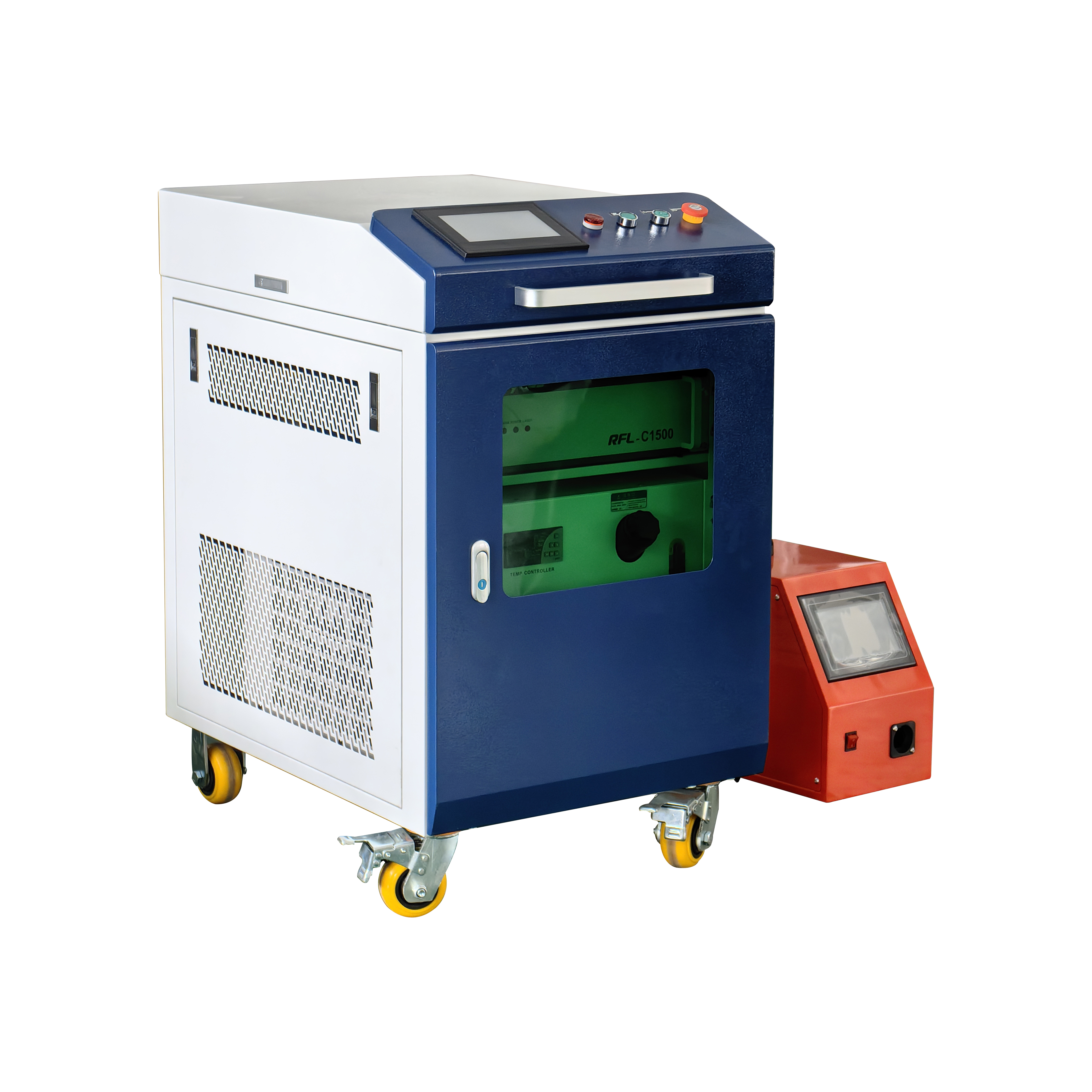
Automated manufacturing lines and multi-shift manual operations demand relentless duty cycles. You cannot afford to pause production to let your equipment cool down. Reliable continuous laser welding requires a thermal management system that runs indefinitely. Water chillers provide this continuous thermal extraction. Air-cooled systems rely on ambient air and heat sinks, forcing you to implement mandatory cool-down periods. Water cooling removes this bottleneck entirely, allowing for true 24/7 manufacturing.
When you integrate a laser welder into a robotic cell or a CNC gantry, the machine often fires for minutes at a time without interruption. This continuous wave operation builds heat exponentially. An air-cooled heat sink will eventually reach thermal saturation, meaning it can no longer absorb heat faster than the laser generates it. At this point, the system software will trigger a thermal alarm and shut down the laser to prevent damage. A refrigerated water chiller actively removes heat from the coolant loop, preventing thermal saturation regardless of how long the laser fires.
Your cooling requirements scale aggressively with your laser power. Welding thick metals, such as stainless steel or aluminum over 3mm, requires sustained high power. You will typically operate at or above 1500W to achieve full penetration on these materials. This intense energy output easily overwhelms standard forced-air heat sinks. Water possesses a significantly higher specific heat capacity than air. It absorbs and transports massive thermal loads away from the optics, keeping high-power operations stable.
Aluminum and copper present unique challenges. These highly reflective and thermally conductive materials require massive amounts of energy to establish a stable keyhole weld. You must hit the material with maximum power instantly to overcome its natural reflectivity. This sudden spike in energy puts immense thermal stress on the delivery optics. Water cooling ensures the optics remain at a stable temperature during these high-power bursts, preventing the focal point from shifting just as the weld pool forms.
The ambient temperature of your facility dictates your cooling strategy. Air cooling relies on a temperature differential, known as delta-T, between the hot heat sink and the surrounding factory air. If your ambient factory air exceeds 30°C to 40°C, this differential collapses. The air can no longer absorb enough heat. Your system will suffer from thermal derating and eventual shutdown. Active water refrigeration becomes mandatory here. A chiller mechanically cools the fluid, maintaining the laser's operating window regardless of the sweltering factory conditions.
Consider a fabrication shop in a southern climate during the summer. The ambient air temperature near the ceiling where heat rises can easily exceed 40°C. If you pull this hot air into an air-cooled laser welder, you are effectively trying to cool a hot component with hot air. The heat transfer rate drops to near zero. A water chiller uses a compressor and refrigerant gas to actively chill the water down to a setpoint of 22°C, guaranteeing a massive temperature differential and efficient heat extraction regardless of the weather outside.
Modern fabrication often requires a single fiber laser source to perform multiple tasks. You might need to switch between a handheld welding head and a dedicated cutting head. Cutting operations demand sustained, high-power energy output to pierce and sever thick plates. This dual-purpose adaptability generates extreme, fluctuating thermal loads. Only a dedicated water chiller can stabilize the laser source across these drastically different processing requirements.
When you switch from welding thin sheet metal at 500W to cutting 10mm steel plate at 2000W, the thermal load on the laser source quadruples instantly. An air-cooled system struggles to adapt to these rapid changes in heat generation. A water-cooled system, equipped with a proportional-integral-derivative (PID) controller, detects the increase in heat load and ramps up the compressor speed to maintain the coolant temperature. This dynamic response allows you to switch between processes seamlessly without waiting for the machine to stabilize.
You must weigh the technical trade-offs between air and water thermal management architectures. Each approach solves the heat problem differently, impacting your daily operations, maintenance schedules, and floor space. Understanding these differences helps you specify the right equipment for your specific fabrication environment.
A water cooled laser welder pumps chilled fluid directly through the laser cavity and around the optics. This direct contact results in incredibly tight temperature tolerances, often maintaining ±0.5°C. This stability guarantees highly repeatable weld profiles. Maintaining a stable beam profile prevents power attenuation. You can run your machine at maximum travel speeds without suffering any quality loss. Active cooling directly correlates to higher processing speeds and superior joint integrity.
When the beam profile remains stable, the energy density at the focal point remains constant. This allows the operator to maintain a steady travel speed along the joint. If the optics heat up and the focal point shifts, the energy density drops. The operator must then slow down to achieve the same penetration, reducing overall productivity. Water cooling eliminates this variable, allowing you to lock in your parameters and run the machine at its maximum theoretical speed all day long.
Water-cooled systems carry a physical penalty. They require an integrated or external industrial chiller, which significantly increases the size, weight, and overall footprint of the machine. You cannot easily drag a heavy chiller unit across a large job site. Air-cooled units offer superior mobility. You should prefer air-cooled systems for space-constrained shops, frequent relocation, on-site field fabrication, or outdoor work where lugging a water chiller is impractical.
A typical 1500W air-cooled laser welder might weigh 40kg and fit in the trunk of a car. A comparable water-cooled system, including the chiller and coolant, can easily weigh over 150kg and requires a dedicated cart or pallet jack to move. If your business model involves traveling to customer sites to perform repairs on heavy machinery or structural steel, the portability of an air-cooled unit outweighs the continuous duty cycle benefits of water cooling. However, for fixed-station manufacturing, the footprint is rarely a deciding factor.
Your maintenance routines will differ drastically based on your cooling choice. Air-cooled machines generally require basic filter cleaning and fan inspections. Water-cooled systems demand a stricter maintenance regimen. You must perform regular coolant level checks. You have to manage algaecide and corrosion inhibitor concentrations. You must also schedule periodic chiller flushing to prevent blockages. Ignoring this maintenance will destroy the chiller pump and overheat the laser source.
Water cooling loops are susceptible to biological growth and galvanic corrosion. If you mix different metals in the cooling loop without proper inhibitors, the water acts as an electrolyte, causing the less noble metal to corrode rapidly. This creates debris that clogs the micro-channels in the laser heat sinks. You must adhere to a strict maintenance schedule to keep the fluid clean and chemically balanced.
Technical Comparison: Air-Cooled vs. Water-Cooled Systems | ||
Feature | Air-Cooled Systems | Water-Cooled Systems |
|---|---|---|
Maximum Continuous Power | Typically limited to 1200W - 1500W | Scales to 3000W+ easily |
Ambient Temperature Limit | Derates above 30°C, fails near 40°C | Operates reliably up to 45°C+ |
Portability | High (suitcase or small cart size) | Low (requires heavy integrated chiller) |
Maintenance Complexity | Low (clean air filters, check fans) | High (fluid changes, filter swaps, chemistry checks) |
Duty Cycle | Intermittent (requires cool-down periods) | 100% Continuous (24/7 operation) |
Installing a water-cooled system introduces specific facility challenges. You must prepare your environment to handle the demands of active refrigeration and fluid dynamics. Failing to address these requirements before installation leads to premature equipment failure and frustrating troubleshooting sessions.
You face a critical risk of condensation forming on internal optics if you operate in high-humidity environments. This happens when the chiller temperature is set below the ambient dew point. Moisture will literally sweat onto the delicate lenses, causing immediate catastrophic failure when the laser fires. You mitigate this by implementing environmental controls in your facility. You must also carefully manage your chiller setpoints to stay safely above the dew point while still providing adequate cooling.
If your factory is 35°C with 80% relative humidity, the dew point is extremely high. If you set your chiller to 22°C, water will immediately condense on the cold metal surfaces of the welding head and the internal oscillator components. When the laser beam hits a water droplet on a lens, the droplet boils instantly, shattering the optic. You must use a psychrometric chart to determine the dew point in your shop and set your chiller temperature at least 2°C above that point. Many modern chillers include smart controllers that monitor ambient temperature and humidity to adjust the water temperature automatically, preventing condensation.
You cannot use standard tap water in an industrial laser chiller. Tap water contains minerals that cause scaling and electrical conductivity issues. You must use purified water, specifically deionized or distilled water. You must mix this pure water with manufacturer-approved corrosion inhibitors. These additives prevent galvanic corrosion within the laser's internal cooling loops. Failing to use the correct fluid mixture will void your warranty and destroy the equipment.
The electrical conductivity of the coolant is a critical parameter. Fiber lasers use high-voltage components near the cooling channels. If the water becomes too conductive due to dissolved minerals or metal ions, it can cause electrical arcing, destroying the laser diodes. You must use a conductivity meter to check the water quality regularly. Most manufacturers require the coolant conductivity to remain below 10 microsiemens per centimeter (µS/cm). When the conductivity rises above this threshold, you must drain the system, flush it, and replace the fluid.
Drain the existing coolant completely from the chiller reservoir and the laser source lines.
Flush the system with pure distilled water to remove loose debris and old chemical residue.
Mix the new batch of deionized water with the exact ratio of corrosion inhibitor specified by the manufacturer.
Fill the reservoir and run the chiller pump to bleed all trapped air from the cooling lines.
Test the final mixture with a conductivity meter to ensure it falls within the acceptable range.
Water-cooled systems draw significantly more power than their air-cooled counterparts. You must provide dedicated electrical circuits to handle the combined draw of the high-power laser source and the chiller's refrigeration compressor. You need to route your utilities carefully to avoid voltage drops. Ensure your facility's electrical infrastructure can support the continuous amperage required by heavy-duty industrial chillers.
A 2000W water-cooled laser welder might require a 220V single-phase or 380V three-phase power supply capable of delivering 30 to 50 amps continuously. If you plug this machine into an undersized circuit, the voltage will drop when the chiller compressor kicks on. This voltage sag can cause the laser power supply to fault out or damage the sensitive control electronics. You must consult with a licensed electrician to run dedicated, properly sized wiring from your main breaker panel directly to the machine installation site.
A water-cooled system is an indispensable asset for high-power, high-duty-cycle, and high-precision industrial environments. It guarantees beam stability and allows for relentless production schedules. Air-cooling remains a viable option, but it is strictly reserved for lower-power, highly mobile, or intermittent fabrication tasks.
Audit your facility's ambient temperature during peak summer conditions to determine your true cooling needs.
Calculate your exact required daily duty cycle based on your current and projected production targets.
Consult with a laser welding applications engineer to size the appropriate chiller and laser source for your specific material thicknesses.
Establish a strict maintenance schedule for fluid checks and filter replacements before the machine arrives on your floor.
A: Yes. Many high-power continuous wave water-cooled sources can integrate with cutting heads. The control software and optics must be compatible. The integrated chiller easily handles the sustained thermal load generated by heavy-duty cutting processes.
A: When ambient temperatures consistently exceed 30°C to 40°C (86°F - 104°F), air-cooled systems suffer from severe thermal derating. At this threshold, active water cooling becomes necessary to maintain operation.
A: You should typically replace the coolant every 3 to 6 months. This depends heavily on the manufacturer's specifications, your operating environment, and the specific type of corrosion inhibitors used in the system.
A: Not inherently faster based on cooling physics alone. However, water cooling allows the laser to operate continuously at maximum power without thermal throttling. This stabilizes the beam spot, directly enabling higher consistent travel speeds.
A: You must use purified water, specifically deionized or distilled water. This water is mixed with manufacturer-approved algaecides and anti-corrosion additives to prevent internal scaling and dangerous electrical conductivity issues.


