
Views: 0 Author: Site Editor Publish Time: 2026-09-30 Origin: Site


Tired of slow and messy sandblasting on massive industrial projects? Traditional surface preparation methods consistently fall short when confronted with huge and complex structures. They are notoriously slow. They demand heavy labor. Furthermore, environmental regulations increasingly restrict their use. Enter the continuous wave laser. This is a brute-force yet highly controllable tool designed to strip decades of grime in a fraction of the time.
Industry trends show a rapid and undeniable shift. Heavy manufacturing is aggressively migrating away from abrasive blasting. Facility managers face stringent worker safety regulations regarding silica dust exposure alongside strict corporate sustainability mandates. They need cleaner alternatives immediately. This shift goes far beyond simple regulatory compliance. It represents a strategic move to eliminate the logistical nightmares of consumable waste disposal. It drastically reduces facility downtime. Investing in a reliable continuous laser cleaning machine solves these challenges efficiently. It fundamentally transforms how heavy industries approach surface restoration.
In this comprehensive engineering guide, we will break down exactly how this technology works. We will explore its core mechanics and highlight the best industrial applications to help you make a sound equipment investment.
To grasp how these systems process massive areas, we must examine the underlying physics. A continuous wave laser emits a constant and uninterrupted beam of light. Pulsed lasers release energy in short high-intensity bursts. Conversely, a continuous wave laser maintains a steady output of optical power. The active medium is typically a fiber optic cable doped with rare-earth elements. This medium is continuously pumped with energy. The result is a stable and relentless stream of photons.
When this continuous beam interacts with surface contaminants, it initiates a process known as photothermal ablation. Dark-colored contaminants like iron oxide or industrial epoxies absorb the intense heat much faster than the reflective metal substrate beneath them. This rapid absorption causes the rust or paint to heat up, vaporize, and detach from the base material almost instantly. Because the energy stream never pauses, the ablation process occurs seamlessly across the material surface. It leaves a perfectly clean trail in its wake.
Maintaining continuous power provides a critical operational advantage for large-scale operations. Lower-power or entry-level pulsed machines often exhibit a noticeable lag when moving across a surface. This requires the operator to move at a painstakingly slow pace to ensure complete contaminant removal. A continuous beam eliminates this lag entirely by providing sustained thermal energy.
This sustained heat generation is highly effective for thick and stubborn layers of corrosion spread across wide areas. The constant energy input prevents the material from cooling down between laser passes. Consequently, multi-layered rust or heavy-duty industrial coatings reach their vaporization threshold quickly. Operators can maintain a steady fluid walking pace. This is much like using a wide-nozzle pressure washer. It drastically reduces the total time required to process massive industrial components.
A raw laser beam is relatively narrow. It often measures only a fraction of a millimeter in diameter. To clean large areas efficiently, the equipment relies on advanced galvanometer scanners located within the laser head. These scanners contain motorized mirrors that oscillate at extremely high speeds. They sweep the narrow beam back and forth to create a wide and continuous cleaning path.
In modern continuous systems, this scanning width can often be adjusted between 150mm and 300mm. By projecting a wide line of continuous energy, the machine covers significantly more square footage per pass than traditional mechanical grinding. The operator simply guides the broad beam over the surface. This ensures uniform coverage without missing spots or creating uneven textures.
The defining metric for processing expansive areas is raw power output. Continuous lasers typically operate at high wattages commonly ranging from 1000W to 3000W. This high energy density is the primary driver for heavy-duty applications. While lower-power 200W to 300W pulsed systems achieve high speed rust removal on smaller delicate components, continuous lasers scale this capability up for massive infrastructure.
When utilizing a 2000W or 3000W system, the laser delivers enough continuous thermal energy to vaporize thick oxidation instantly upon contact. The operator does not need to pause and let the machine catch up to the rust layer. The higher the wattage, the faster the linear scanning speed can be set. This directly translates to higher square-meter-per-hour productivity rates on large shipyard or pipeline projects.
Massive industrial structures often suffer from deep multi-layered corrosion rather than superficial flash rust. Continuous lasers manage this through aggressive deep thermal ablation. Because the laser maintains a high thermal threshold, it aggressively burns off the top layers of paint and the underlying rust simultaneously.
While the heat is intense, modern systems allow for precise parameter control. By adjusting the scanning speed and focal length, operators can ensure that the continuous energy remains focused strictly on the contaminant layer. Once the rust is vaporized, the reflective nature of the bare steel substrate bounces much of the remaining laser light away. This prevents the base metal from absorbing excessive heat and warping.
Selecting the correct laser technology depends entirely on the specific requirements of your project. Both continuous and pulsed lasers are incredibly effective. However, they are engineered for vastly different industrial sectors. Let us look at a direct engineering comparison.
| Feature | Continuous Wave Laser | Pulsed Laser |
|---|---|---|
| Energy Delivery | Uninterrupted constant stream of photons. | High-intensity nanosecond bursts. |
| Best Application | Massive surface areas, thick rust, marine paint. | Delicate substrates, molds, historical artifacts. |
| Substrate Impact | High heat. Safe for thick steel but may warp thin metals. | Cold cleaning process. Zero thermal distortion. |
| Large Area Speed | Extremely fast. High square-meter-per-hour output. | Slower. Requires precise overlapping passes. |
| Cost Efficiency | Highly cost-effective per watt. Faster ROI for heavy industry. | Higher initial cost due to complex internal optics. |
Continuous lasers are the definitive choice when scale, speed, and bulk material removal are the primary objectives. They are highly recommended for robust base materials. These include thick steel plates, heavy machinery, and structural iron where micro-heating of the substrate does not pose a structural risk.
For facilities looking to overhaul massive infrastructure, investing in a continuous laser provides the necessary brute-force power to strip away decades of industrial coatings. Because they are significantly more cost-effective per watt than their pulsed counterparts, they offer a faster return on investment for shipyards and heavy manufacturing plants focused on broad surface preparation.
In contrast, pulsed lasers are engineered for absolute precision. Because the energy is delivered in nanosecond bursts, the substrate has time to cool down between pulses. This results in a cold cleaning process. This makes pulsed systems ideal for delicate substrates, thin sheet metals, aerospace components, and injection mold cleaning where zero thermal distortion is strictly mandated.
If your operation involves restoring precise machinery or performing meticulous industrial surface cleaning without altering the base material metallurgical properties, a high-efficiency pulsed laser is the scientifically sound choice. For these highly precise tasks, the aggressive heat of a continuous wave laser would be a liability rather than an asset.
The marine industry faces some of the most severe corrosion challenges due to constant saltwater exposure. Continuous laser cleaners are heavily utilized in shipyards for maintaining massive ship hulls, cargo holds, and steel decks. Consider a shipyard worker tasked with stripping marine epoxy from a large hull. Instead of wrestling with a heavy sandblasting hose while enclosed in a stifling respirator suit, the operator smoothly glides a handheld laser optic over the steel. The laser effectively removes stubborn barnacles, thick salt corrosion, and multi-layered marine-grade paints without leaving tons of contaminated sand in the drydock.
Pipelines stretch for miles across unforgiving terrains. They require rigorous maintenance to prevent catastrophic failures. Continuous lasers are highly effective for pre-weld and post-weld cleaning on massive steel pipes. Before welding, the laser rapidly removes crude oil residue, moisture, and heavy oxidation to ensure a flawless weld seam. After welding, it effortlessly removes heat tint and weld slag. The speed of a continuous laser allows maintenance crews to process long stretches of pipeline efficiently. This minimizes critical facility downtime.
Refurbishing heavy construction equipment like cranes, excavators, and bulldozers requires stripping away thick hardened industrial paint and rust. Similarly, maintaining bridge supports and structural steel frameworks demands a high-yield cleaning solution. Continuous lasers strip these massive structures down to bare metal quickly. Furthermore, because the process does not create secondary waste, it can be performed on-site without enclosing the entire bridge or machine to contain abrasive dust clouds.
Traditional large-area cleaning methods rely heavily on consumables. Companies must continuously purchase, transport, store, and eventually dispose of sand, glass beads, or chemical solvents. A continuous laser eliminates these operational expenses entirely. The only input required to run the machine is electricity. Over the lifespan of the equipment, the massive reduction in consumable costs and hazardous waste disposal fees often offsets the initial capital expenditure of the laser system.
Environmental and workplace safety regulations are becoming increasingly stringent globally. Sandblasting generates massive amounts of airborne particulate matter. This includes silica dust which poses severe respiratory risks to operators. Chemical stripping involves toxic volatile organic compounds and hazardous runoff. Laser cleaning is a dry and contact-free process. When paired with a standard industrial fume extractor, the vaporized rust and paint are safely captured at the source. This results in zero hazardous chemical runoff and no toxic dust clouds.
In heavy industry, downtime equates to lost revenue. Continuous lasers are built with industrial-grade fiber optic sources that can operate on continuous duty cycles. Additionally, the laser beam only targets the specific area it is pointed at. There is rarely a need to intricately mask off adjacent mechanical components, hydraulic lines, or sensitive wiring. This localized and high-speed approach ensures that large-area maintenance is completed with maximum operational efficiency.
Modern handheld laser cleaning guns are designed with ergonomics in mind. However, cleaning large areas manually has inherent physical limitations. Human operators inevitably experience fatigue when holding and sweeping a laser gun over a massive storage tank for an eight-hour shift. As operator fatigue sets in, the scanning speed becomes inconsistent. This inconsistency can lead to uneven cleaning results or unintentional heat buildup in specific spots where the operator hand lingers too long.
To maximize the potential of a continuous laser on massive surface areas, the technology can be fully automated. The laser cleaning head can be detached from its handheld configuration. It is then mounted onto programmable robotic arms, CNC gantry systems, or magnetic wall-crawling robots.
Automation ensures a perfectly uniform cleaning path. The robotic system maintains a consistent focal length, an exact travel speed, and a precise overlap between passes. This integration allows facilities to achieve high-speed uniform cleaning over hundreds of square meters continuously. It completely eliminates human fatigue and dramatically increases throughput in manufacturing environments.
Selecting the appropriate wattage is the most critical engineering decision when configuring a system for large areas. Higher wattage directly correlates to the volume of material that can be vaporized per second.
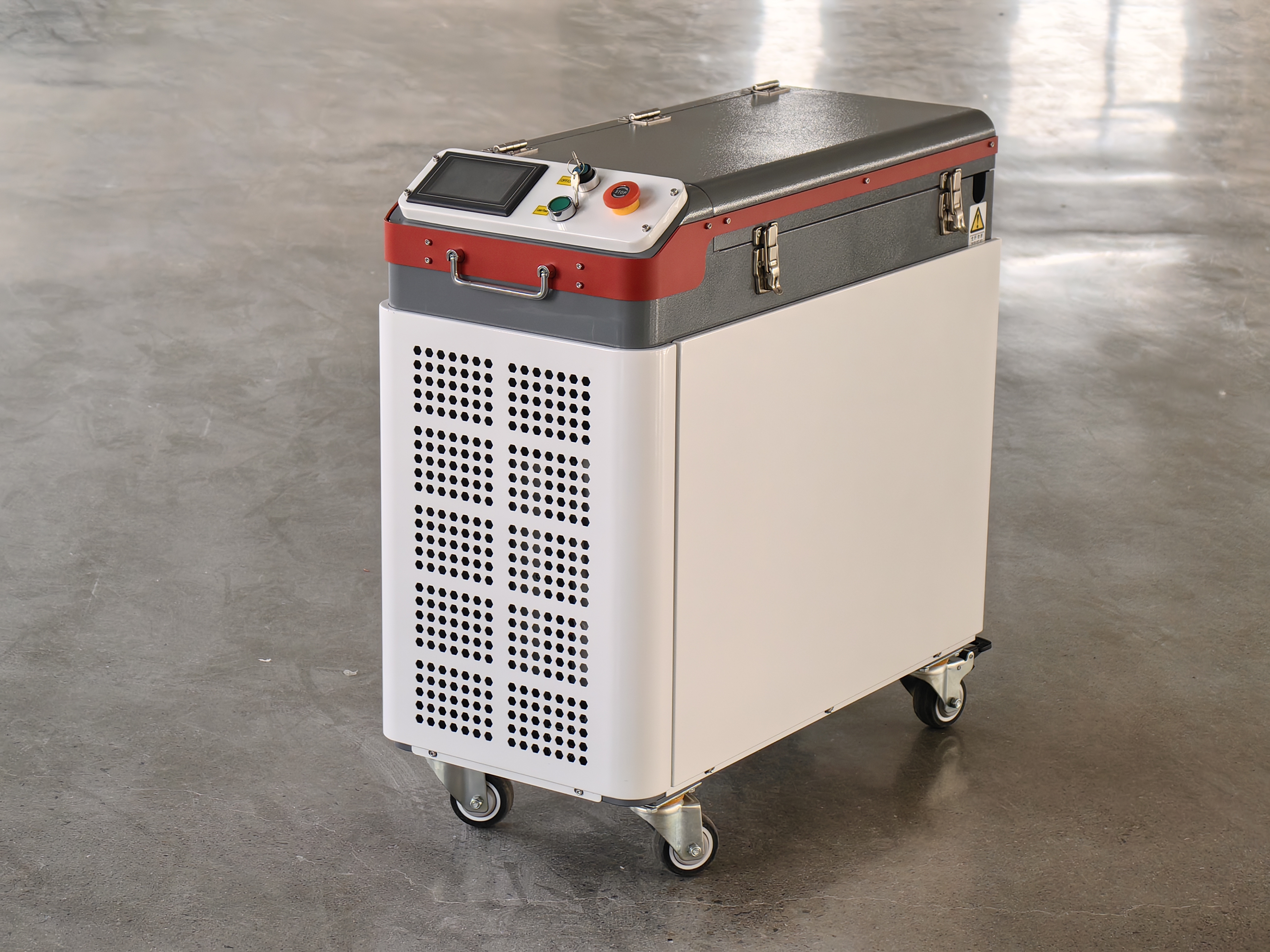
Continuous wave lasers operate with a wall-plug efficiency of approximately 30 to 40 percent. This means a significant portion of electrical energy is converted into heat. For high-power continuous operation, a robust industrial water chiller is mandatory. Prospective buyers must ensure the machine is equipped with a dual-temperature water chiller that regulates both the fiber laser source and the optics independently. A reliable cooling system guarantees that the machine can maintain 24/7 operation without thermal lensing or emergency thermal shutdowns.
When cleaning large infrastructure, the operator often needs to navigate around scaffolding, ship decks, or large machinery. The main cabinet of a high-power laser machine can weigh upwards of 200 kilograms. This makes it impractical to hoist into tight spaces. Therefore, the length of the fiber optic delivery cable is crucial. Industrial continuous lasers should be equipped with an armored cable length of at least 10 to 15 meters. This allows the heavy main cabinet to remain safely stationary on the ground while the operator navigates the large surface area with the lightweight laser head.
Tackling massive surface areas requires reliable industrial-grade equipment. A continuous laser cleaning machine offers unmatched processing speed. It provides the sustained brute-force power needed for large-scale operations like shipbuilding, pipeline maintenance, and heavy machinery restoration. By eliminating consumables and slashing facility downtime, these systems represent the future of industrial surface preparation.
Before investing, evaluate your specific speed, scale, and thermal requirements very carefully. If your facility needs to overhaul massive heavy-duty steel structures, a high-power 1000W to 3000W continuous system is your best asset. If your process requires zero thermal impact on delicate parts, explore high-efficiency pulsed options. Ready to upgrade your surface preparation workflow? Visit Easy CNC Laser to explore professional continuous laser cleaning machines and high-efficiency pulsed laser systems tailored to your industrial needs.
The speed of rust removal depends on three converging variables. These are the wattage of the continuous laser source, the grade and thickness of the oxidation, and the thermal conductivity of the underlying substrate. Because continuous lasers do not pause their energy output, they achieve the highest square-meter-per-hour rates in the industry. For example, when dealing with moderate flash rust on structural steel, a 1500W continuous laser with a 150mm scanning width can typically clean between 10 to 15 square meters per hour. If the power is increased to 3000W on the same material, the speed can easily exceed 25 to 30 square meters per hour.
When operated correctly and calibrated to the appropriate parameters, a continuous laser will not damage robust industrial base metals like carbon steel, cast iron, or thick structural alloys. The technology relies on ablation thresholds. Rust and paint have a significantly lower ablation threshold than the underlying metallic substrate. When the bare metal is exposed, its highly reflective surface bounces a large portion of the remaining laser light away. However, because continuous lasers introduce a constant stream of heat, there is a risk of thermal distortion if used improperly on very thin sheet metals under 2mm. Operators are trained to maintain a steady walking pace to ensure the heat-affected zone remains negligible.
Yes, continuous lasers are exceptionally effective for heavy-duty industrial surface cleaning. This includes the removal of thick industrial coatings, marine epoxies, and anti-corrosion paints. The sustained thermal energy is particularly adept at breaking down complex polymer chains through photothermal degradation. Unlike traditional chemical strippers that require hours to soften thick coatings, the continuous laser instantly burns and vaporizes the paint layer by layer. For extremely thick coatings, operators typically utilize a rapid multi-pass strategy to expose the bare substrate without overheating the metal.
The price disparity is primarily driven by the complexity of the internal laser source architecture. Generally, continuous wave lasers are significantly more cost-effective on a price-per-watt basis compared to pulsed laser systems. A continuous fiber laser uses a relatively straightforward optical cavity to produce a steady stream of light. Economies of scale have driven manufacturing costs down. Conversely, pulsed lasers require highly sophisticated internal electronics to modulate the beam into nanosecond bursts. This makes them much more expensive to manufacture. Therefore, for buyers focused on large-area bulk material removal where thermal impact is not a primary concern, continuous lasers offer a vastly superior return on investment.
Safety is paramount when operating Class 4 industrial lasers. The most critical piece of equipment is a pair of laser safety goggles specifically rated for the exact wavelength of the fiber laser, which is typically around 1064nm. Operators must never look at the beam without these certified glasses. Additionally, while the process does not create heavy abrasive dust, vaporizing paint and rust generates fumes. Therefore, a high-quality industrial fume extractor is necessary to capture hazardous vapors at the source. Standard heavy-duty gloves and long sleeves are also recommended to protect the skin from scattered light reflections.
While continuous fiber lasers are incredibly effective on metals, they are generally not recommended for porous materials like concrete, brick, or stone masonry. The intense heat generated by a continuous wave laser can cause the moisture trapped inside the concrete to expand rapidly. This leads to micro-cracking, spalling, or surface damage. For cleaning historical stone buildings or removing graffiti from concrete, specialized low-power pulsed lasers or alternative cleaning methods are typically required to prevent structural degradation.


