
Views: 0 Author: Site Editor Publish Time: 2026-11-15 Origin: Site


You invest heavily in cutting equipment, expecting flawless precision. Yet, achieving clean edges on thick plates remains a persistent headache for many shop floors. When high-wattage systems fail to deliver, poor parameter optimization is usually the culprit behind severe slag and taper issues. In this guide, we walk you through the essential steps to refine your hardware and software settings. By adjusting these variables, you can restore your machine to peak performance and make industrial metal cutting the reliable backbone of your production.
The metal fabrication market is rapidly shifting toward ultra-high wattage systems. Shops are moving past standard 4kW setups, increasingly adopting 12kW, 20kW, or even 30kW sources to process thicker materials at unprecedented speeds. However, this trend exposes a critical operational gap. Raw power alone cannot guarantee a clean edge. As the industry embraces automation and high-mix production, the real competitive differentiator is beam stability and intelligent parameter control. Operators are realizing that managing thermal dynamics is far more important than simply turning up the dial.
When evaluating cutting equipment, wattage is often the first metric discussed. Laser power directly dictates the energy density delivered to the material surface. Higher wattage increases the melting rate, allowing operators to process thicker materials at significantly faster speeds. Raw power, however, is only one part of the equation.
Beam quality, frequently quantified by the M2 factor, is equally critical. A lower M2 value indicates a highly focused beam capable of producing a narrow kerf and exceptionally smooth edges. When the beam quality degrades, energy scatters. This scattering leads to wider cuts, increased heat-affected zones, and rough edge finishes. If the optical components are not matched to handle high-kilowatt outputs, thermal lensing can occur. This phenomenon shifts the focal point mid-cut, resulting in inconsistent quality across large metal sheets.
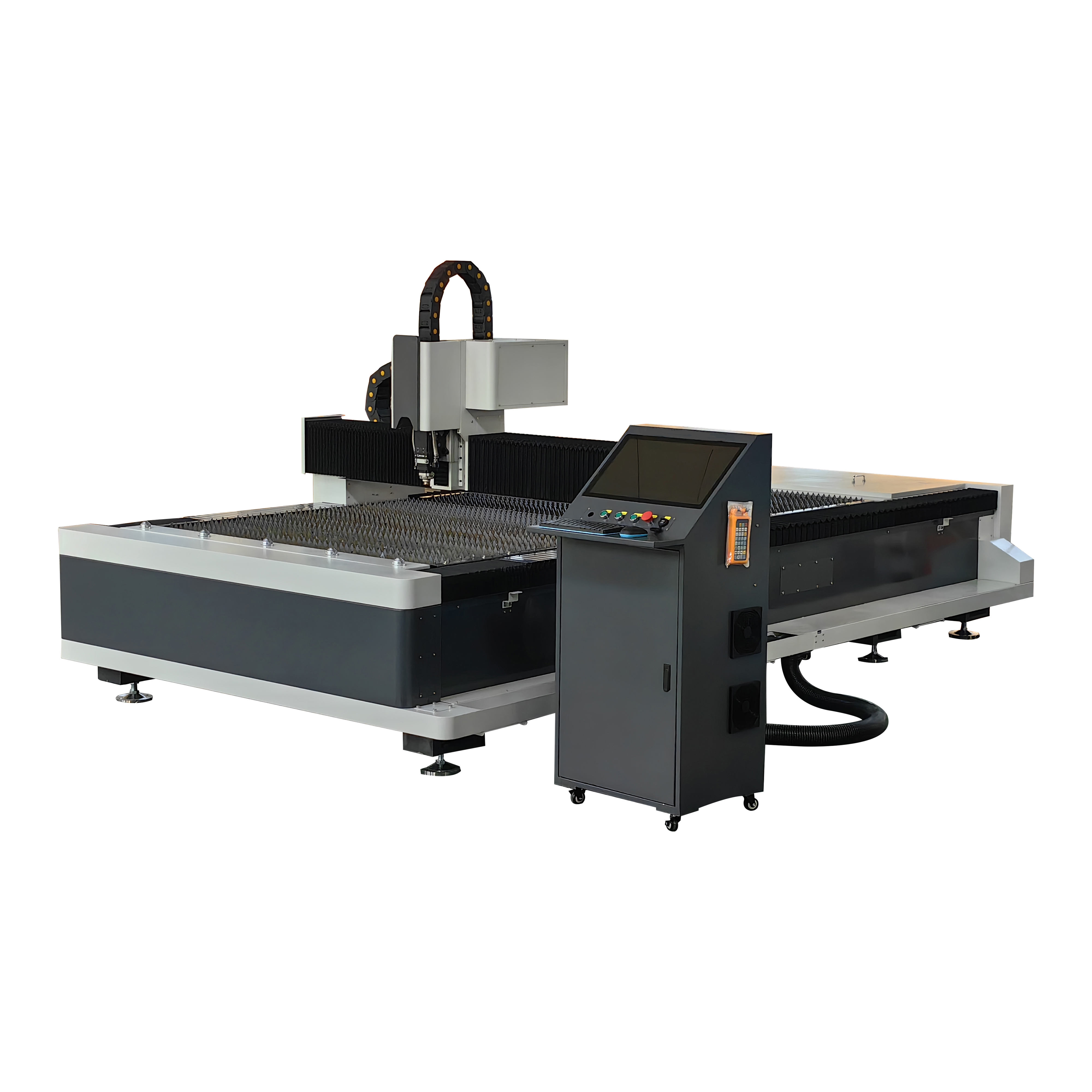
Processing heavy materials introduces complex thermal dynamics. Successful thick plate laser cutting demands precise control over multiple variables to evacuate molten metal efficiently without causing excessive heat buildup.
The focal position dictates exactly where the highest concentration of laser energy intersects the material. For thin sheets, operators typically set the focus at or slightly above the surface. In contrast, thick plate applications require a negative focal position. This specific adjustment ensures the kerf remains wide enough at the bottom, allowing the auxiliary gas to expel the molten slag effectively. In parallel, auxiliary gas serves to cool the cutting zone and blow away the melt. Oxygen triggers an exothermic reaction ideal for carbon steel. Nitrogen relies entirely on kinetic energy to shear away metal, a process essential for stainless steel to prevent edge oxidation.
Even with flawless software parameters, hardware degradation will immediately compromise your output. The nozzle acts as the aerodynamic control center for your auxiliary gas. Using an incorrect nozzle diameter causes gas turbulence. This turbulence drags molten material right back into the kerf, ruining the bottom edge.
Meanwhile, the protective window shields your delicate internal optics from aggressive spatter. A single speck of dust can absorb intense laser energy. This creates localized heat that alters the refractive index of the glass and shifts the focal point. To prevent this, operators must inspect lenses daily in a strict dust-free environment using optical-grade wipes. The beam must pass perfectly through the dead center of the nozzle orifice to avoid directional cutting flaws.
A machine's performance depends heavily on the metallurgical properties and surface conditions of the raw plate. Stainless steel possesses a high viscosity when molten. It resists expulsion from the kerf unless you utilize high-pressure Nitrogen and maintain a very low standoff distance.
Rust, mill scale, and oil on carbon steel introduce unpredictable variables to the cutting process. These surface impurities cause the beam to scatter, frequently leading to plasma blowouts. A blowout is a violent expulsion of molten metal that can instantly destroy a fresh nozzle. Savvy engineers often program a surface vaporization pass. This low-power, high-speed pre-cut strips away contaminants before initiating the actual full-depth cut.
Diagnosing quality issues requires a systematic approach. Dross, the resolidified metal clinging to the bottom edge, serves as a primary indicator of underlying parameter mismatches.
Hard, difficult-to-remove bottom dross usually means the focal position is set too high or the cutting speed is overly aggressive. The beam simply fails to penetrate fully. Soft dross often points to insufficient gas pressure or excessively slow feed rates. Beyond dross, deep vertical striations signal a severe mismatch in the power-to-speed ratio. Minor striations are perfectly normal in thick-plate processing. Deep grooves, however, suggest the beam is dragging or mechanical vibrations from the gantry are transferring chatter marks directly to the workpiece.
| Defect Type | Primary Cause | Engineering Solution |
|---|---|---|
| Hard Bottom Dross | Focal position too high or speed too fast | Lower focal point deeper into material; decrease feed rate. |
| Soft / Stringy Dross | Insufficient gas pressure or speed too slow | Increase auxiliary gas pressure; slightly raise cutting speed. |
| Deep Vertical Striations | Power-to-speed mismatch or gantry vibration | Synchronize speed with wattage; check linear guides for wear. |
| Plasma Blowouts | Surface impurities like rust or mill scale | Run a low-power vaporization pre-pass to clean the surface. |
The mechanical rigidity of the machine chassis is just as vital as the laser source itself. High-speed, high-acceleration movements place immense stress on structural components. Over months of heavy operation, a lack of lubrication or accumulated metal dust causes micro-binding in the linear guides. This mechanical instability directly manifests as poor edge quality.
Modern machines incorporate advanced software compensation and capacitive height-sensing heads to maintain a strict standoff distance. These sensors must undergo regular calibration. If the sensor drifts, the nozzle distance fluctuates unpredictably, completely ruining the carefully tuned gas dynamics. Professional preventative maintenance remains the most cost-effective investment for ensuring long-term dimensional accuracy.
Achieving flawless results becomes significantly easier when your equipment strictly aligns with your daily production demands. Pushing a low-wattage machine to its absolute limit inevitably compromises edge quality and rapidly accelerates consumable wear.
If your facility primarily handles thin sheets under 3mm, investing in a high power fiber laser cutter scaled to the 1500W-2000W range offers an outstanding balance of precision and operational cost. You avoid the massive power draw of larger units while maintaining crisp edges. Conversely, if your core business involves heavy structural components exceeding 10mm, stepping up to a 6000W or higher system is an absolute necessity. Higher wattage allows you to use Nitrogen on thick materials, effectively eliminating oxidation layers and bypassing costly secondary cleaning processes.
Cut quality is a dynamic, ongoing process rather than a static baseline. It demands constant vigilance and a deep engineering understanding of your hardware limits. Whether you are executing high-precision thin-sheet work or tackling demanding heavy industrial tasks, fine-tuning your parameters is the true key to shop floor profitability. Stop losing money to scrap and rework. Assess your current bottlenecks today and choose a system engineered specifically for your rigorous quality standards to elevate your manufacturing capabilities.
Dross accumulation is primarily a fluid dynamics issue related to auxiliary gas pressure and melting rates. The laser melts the metal, but the auxiliary gas must physically eject that molten material down through the kerf. If the pressure is too low, it lacks the kinetic energy to clear the slag. If the focal position is set too high, the beam energy dissipates before reaching the bottom, resulting in an incomplete melt.
For high-volume industrial environments, you should verify beam alignment at least once a week. You must also check it immediately following any accidental collision between the cutting head and a tipped-up part. Even a slight deviation of 0.1mm causes the gas flow to interact unevenly with the laser, resulting in tapered edges on just one side of the cut.
Not necessarily. Higher wattage increases your raw capacity for speed and thickness. However, quality remains a delicate balance of feed rate, focal position, and gas dynamics. Simply increasing power without adjusting your speed causes overburning and severe material warping. Better cuts happen only when CNC parameters are perfectly synchronized with the output of the laser.
Rough edges typically stem from a mismatch between the cutting speed and laser power. They can also result from mechanical vibrations within the gantry system. If the feed rate is too fast, the beam drags behind the nozzle, creating angled striations. If the speed is too slow, excess heat causes the material to boil, leaving a pitted, rough texture.
No. Nozzle selection is a critical variable in gas fluid dynamics. Single-layer nozzles are designed specifically for high-pressure Nitrogen cutting to achieve maximum exit velocity. Double-layer nozzles are engineered for Oxygen, creating a secondary gas shield that stabilizes the exothermic reaction. You must scale the nozzle diameter to the material thickness to ensure proper gas distribution deep into the kerf.
Oxygen is the industry standard for thick carbon steel. It creates an exothermic chemical reaction that adds extra heat to the cutting process, allowing the laser to penetrate much thicker plates than it could with raw power alone. However, the gas pressure must be kept relatively low to prevent the reaction from burning out of control and widening the kerf excessively.
Thermal lensing occurs when optical components become contaminated with microscopic dust or spatter. These contaminants absorb laser energy and heat up, causing the glass to expand slightly. This expansion changes the refractive index and shifts the focal point higher or lower mid-cut. The result is inconsistent edge quality and unpredictable dross formation across large sheets.


