
Views: 0 Author: Site Editor Publish Time: 2026-10-17 Origin: Site


Did you know extreme heat destroys laser equipment? High-power operations generate intense and damaging thermal stress. This inevitably causes poor welds and costly production downtime. As modern manufacturing rapidly adopts industrial laser welding for its unmatched speed and precision, managing this heat has become the ultimate hurdle.
A closed-loop cooling machine solves these exact challenges. By actively extracting thermal energy, this technology allows fabricators to push their equipment to the absolute limit. In this comprehensive guide, you will learn exactly how these advanced cooling systems work, why they outshine air-cooled alternatives, and how to choose the right setup for your production floor.
Thermal Stability: Closed-loop chillers and industrial refrigerants maintain exact operating temperatures. This prevents optical degradation during extended shifts.
Maximum Uptime: Active liquid cooling facilitates true continuous industrial production without the frustrating thermal interruptions common in older systems.
Superior Weld Quality: Consistent temperature regulation prevents focal shift in the laser optics. This ensures uniform penetration and structural integrity across massive production runs.
Measurable ROI: The extended lifespan of the laser source, combined with a drastic increase in daily output, provides a robust return on investment for high-volume facilities.
To truly grasp why thermal management is a make-or-break factor in fabrication, we must look at the physical realities of the factory floor. Industrial environments operate on unforgiving schedules where equipment limitations directly choke profitability.
Looking at recent manufacturing trends, the global shift toward electric vehicles and aerospace lightweighting has driven a massive spike in high-power fiber laser adoption. Facilities are rapidly moving away from traditional TIG and MIG setups, favoring multi-kilowatt lasers to process highly reflective alloys. However, this transition exposes a critical bottleneck. When you run a 3000W laser continuously, the ambient air simply cannot absorb the waste heat fast enough. Active thermal management is no longer an optional upgrade; it is a fundamental requirement for modern heavy industry.
There is a massive operational gap between light-duty hobbyist tasks and heavy-duty fabrication. Light-duty applications typically involve thin gauge materials and short, intermittent bursts of energy. This natural rhythm gives the equipment ample time to dissipate heat into the ambient air.
Furthermore, heavy industry paints a completely different picture. Imagine an automated robotic arm laying down a three-meter continuous seam on a thick carbon steel tank. The power output required for these tasks often surges past 2000W or 3000W, generating an immense volume of concentrated energy. When a laser fires continuously for hours, excess thermal energy cannot simply float away. Without aggressive active intervention, this trapped heat bakes the internal components of the laser source and warps the intricate optics inside the welding head.
The physics of laser generation dictates a harsh reality. Not all electrical energy converts into brilliant light. A significant percentage transforms into raw heat. If this thermal load accumulates within the torch, it triggers a destructive phenomenon known as thermal lensing.
Specifically, thermal lensing happens when protective windows and focusing lenses absorb stray heat, causing the delicate optical glass to expand and distort. Even microscopic warping alters the refractive index of the lens. Consequently, the laser focal point drifts away from the target metal, creating a wider and diluted beam that fails to achieve deep penetration. Operators are left with inconsistent seams, excessive spatter, and structurally weak joints. Prolonged exposure to these temperatures will eventually cause catastrophic failure in the fiber optic delivery cables.
To combat the severe thermal realities of high-volume manufacturing, engineers rely on advanced thermodynamics. In contrast to passive methods, active liquid cooling extracts heat from sensitive electronics exponentially faster than it can accumulate.
The beating heart of this thermal strategy is the closed-loop water chiller. Inside this integrated system, a heavy-duty pump forces a specialized cooling fluid through a labyrinth of micro-channels machined directly into the laser oscillator and the handheld torch.
Because the architecture is entirely closed-loop, the liquid is constantly recycled without ever touching the dirty factory air. As the chilled water rushes over heat-generating diodes, it absorbs thermal energy via rapid conduction. The freshly heated water is then immediately pumped away from the fragile optics and routed back to the main chiller unit. Utilizing deionized water is absolutely critical here. It prevents mineral scale from clogging the microscopic arteries and stops galvanic corrosion dead in its tracks.
Once the warm water returns to the base unit, the real engineering magic happens inside the heat exchanger. This process mirrors a high-powered industrial air conditioner.
The chiller relies on a robust compressor and chemical refrigerants. Thermal energy transfers from the water into the refrigerant, causing it to evaporate. This gas carries the heat to a condenser, where massive industrial fans violently expel it into the room. This aggressive heat exchange guarantees that the water cycling back to the laser is precisely locked at an optimal 22°C to 25°C. Modern intelligent chillers even feature dual-temperature control circuits, providing slightly different cooling temperatures for the laser source and the optical head simultaneously. This unwavering temperature control is the foundational engineering that makes non-stop fabrication possible.
As global supply chains demand faster turnaround times, the reliance on high-power automated systems has surged. Processing thicker and highly reflective alloys requires immense sustained energy, making liquid-cooled thermal management an absolute necessity.
The most lucrative advantage of active chilling is the total eradication of thermal downtime. Basic air-cooled setups are handcuffed by strict duty cycles, often requiring a ten-minute rest for every thirty minutes of trigger time to avoid a meltdown.
By upgrading to a system designed for continuous laser welding, fabricators bypass these restrictions entirely. The equipment can run at maximum output across back-to-back shifts. Transforming a bottlenecked assembly line into a high-throughput powerhouse directly maximizes the daily yield of sellable parts.
Industrial fiber lasers and their precision optics require massive capital investment. Subjecting these delicate components to chronic and fluctuating heat accelerates material fatigue and drastically slashes their lifespan.
Liquid cooling cocoons these sensitive parts in a stable and highly controlled environment. By anchoring internal temperatures well below critical failure thresholds, the degradation of the fiber oscillator slows to a crawl. This proactive thermal defense slashes long-term maintenance budgets, minimizes consumable replacements, and virtually eliminates the nightmare of sudden machine failure mid-production.
In high-stakes sectors like aerospace and automotive, weld integrity is strictly a matter of safety and regulatory compliance. Even minor variations in penetration depth can result in entirely rejected batches.
Because hydronic cooling neutralizes thermal lensing, the beam profile remains razor-sharp from dawn until dusk. Operators are freed from the tedious task of manually tweaking focal settings mid-shift to compensate for a fading laser. Every single weld benefits from uniform penetration and a remarkably narrow heat-affected zone, delivering a clean finish that rarely requires post-weld grinding.
When procurement managers evaluate equipment upgrades, the thermal management system is often the most heavily debated specification. Both technologies have legitimate use cases, but they serve fundamentally different production realities.
The ultimate dividing line between these two formats is raw power capacity. Water boasts a thermal conductivity roughly 24 times higher than air. Consequently, air cooling hits a hard physical ceiling around 1200W to 1500W because it relies solely on ambient room air blowing across aluminum heat sinks.
Conversely, a water cooled laser welder is purpose-built to devour massive thermal loads. These robust systems effortlessly tame 2000W, 3000W, and even higher outputs. If your shop routinely processes thick carbon steel, copper, or aluminum, high wattage is non-negotiable. This makes liquid cooling your only viable path forward.
Historically, the biggest knock against water-cooled rigs was their massive and stationary footprint. Air-cooled units dominated small shops because they lacked bulky external chillers and fluid reservoirs.
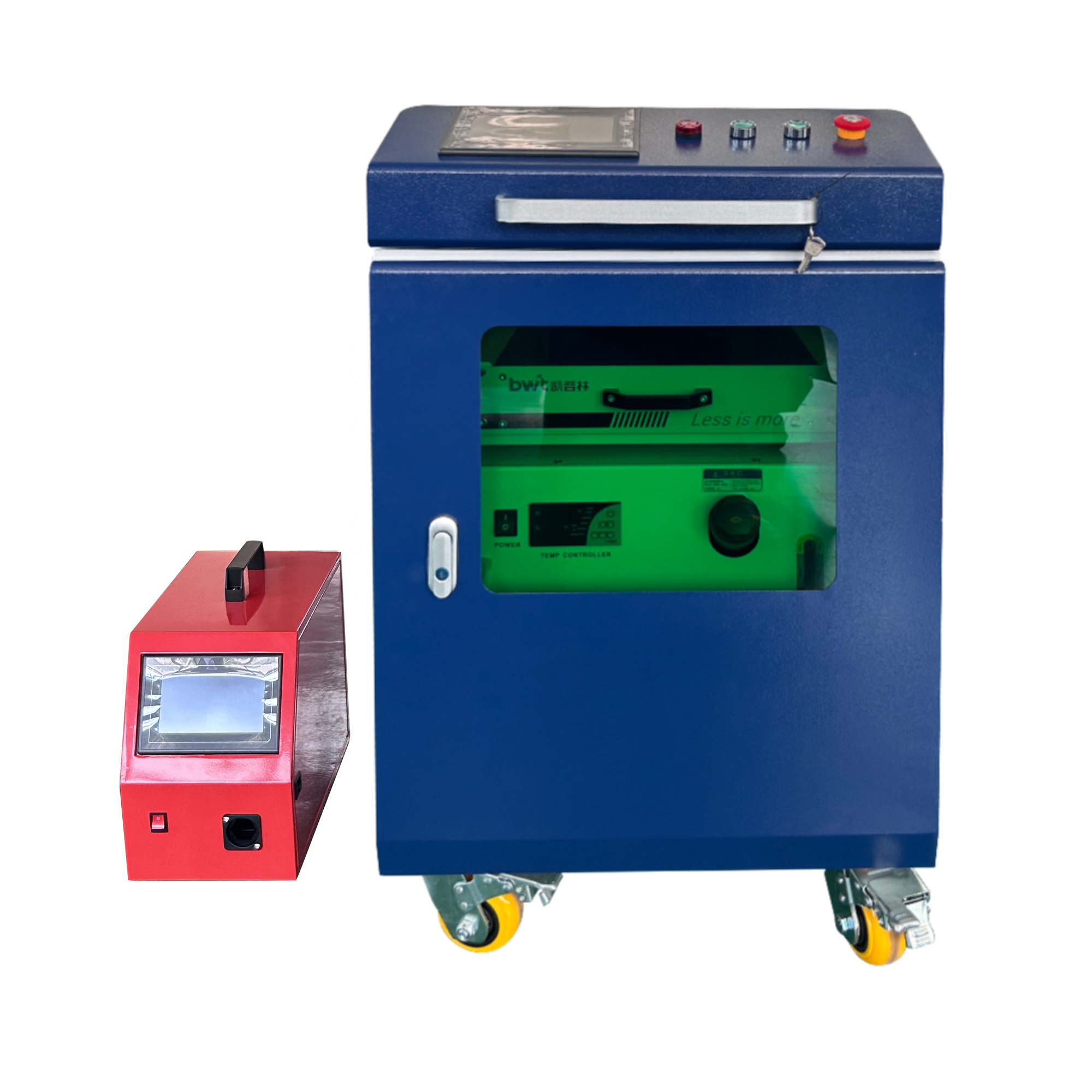
However, modern mechanical engineering has completely bridged this divide. Today industry-leading manufacturers have successfully condensed the chiller, laser source, and intelligent controls into incredibly sleek wheeled cabinets. These highly integrated chassis offer uncompromising industrial-grade cooling while easily gliding across a crowded factory floor.
Air-cooled machines are notoriously fragile in harsh environments. If ambient summer temperatures in a non-air-conditioned warehouse creep past 30°C, or if the air is thick with grinding dust, an air-cooled heat sink quickly chokes. The dust acts like an insulating blanket, causing the machine to overheat and shut down.
Liquid cooling loops are sealed and highly resilient. External metallic dust cannot infiltrate the internal heat transfer mechanism. While the active compressor does draw slightly more electricity, the ability to maintain relentless production speeds in hot and filthy environments aggressively drives down the overall cost-per-part.
Feature |
Air-Cooled Systems |
Water-Cooled Systems |
|---|---|---|
Cooling Medium |
Ambient Air & Fans |
Closed-Loop Chilled Water |
Maximum Power |
Generally up to 1500W |
1500W, 2000W, 3000W and above |
Duty Cycle |
Intermittent resting required |
100% Continuous Operation |
Environmental Tolerance |
Poor in hot or dusty conditions |
Excellent in harsh factory settings |
Best Application |
Light sheet metal and short runs |
Heavy industry, thick metals, automation |
Moving beyond theoretical physics, it is crucial to see how this technology fundamentally transforms specific heavy-duty sectors.
The explosive growth of the electric vehicle market forces manufacturers to weld complex battery pack enclosures and lightweight aluminum chassis components. These highly reflective alloys demand immense initial laser power to pierce the surface. Active liquid cooling ensures that automated robotic cells can operate continuously. This maintains microscopic precision across tens of thousands of identical parts without a hint of thermal drift.
Fabricating commercial stainless steel sinks, countertops, and HVAC ductwork requires exceptionally long seam welds. If an operator has to pause mid-seam because their torch is overheating, it creates structural weak points and ugly start-stop blemishes. Water-chilled equipment empowers operators to glide through three-meter passes seamlessly. The hyper-focused heat input prevents the thin stainless steel from warping, which is a notorious headache associated with traditional TIG welding.
Selecting the perfect fabrication equipment requires a hard and objective look at your current production bottlenecks and future scaling goals. As an engineer, I always advise shops to look at their actual daily throughput rather than just the upfront price tag.
The most reliable metric for deciding on a thermal management system is your daily trigger time. As an industry rule of thumb, if your team is actively welding for more than two hours a day, an air-cooled setup will inevitably cause frustrating delays. Furthermore, modern liquid-cooled chassis now offer incredible versatility. Advanced 4-in-1 handheld machines integrate welding, cutting, weld seam cleaning, and remote rust removal into a single unit. This multi-functional approach drastically reduces the need for secondary processing equipment.
Your material specifications strictly dictate your wattage. While joining 1mm to 3mm stainless steel might only demand a 1500W power source, achieving full structural penetration on 4mm to 8mm aluminum or carbon steel requires 2000W to 3000W. High wattage mandates superior heat extraction.
If your shop handles a wildly diverse range of metals and thicknesses, you need a versatile and high-capacity system. Upgrading to a multi-functional water-cooled unit provides the thermal headroom necessary to scale your operations safely. This allows you to tackle thicker plates without fear of optical meltdowns.
To protect your capital investment and guarantee decades of reliable service, strict adherence to maintenance protocols is non-negotiable. Proper preventative care eliminates the vast majority of cooling-related failures.
The fluid coursing through the chiller is the lifeblood of the entire machine. Never under any circumstances use standard tap water. Tap water is loaded with calcium and magnesium that will rapidly calcify inside the microscopic channels of the laser cavity. This leads to irreversible thermal damage.
Check the fluid reservoir weekly. Completely drain, flush, and replace the circulating deionized water every one to three months, depending on how dusty your shop is. Monitoring the electrical conductivity of the water is also vital to prevent galvanic corrosion between internal metal fittings.
A silent killer in humid climates is condensation. If the chiller fluid is significantly colder than the muggy factory air, moisture will rapidly condense on the exterior of the laser optics. When the laser fires through a microscopic water droplet, the droplet instantly vaporizes and shatters the expensive protective lens.
Always configure the target temperature of the chiller relative to the ambient room dew point. Modern intelligent chillers feature dual-temperature modes that automatically adjust the fluid temperature based on real-time environmental sensors. This safely neutralizes the threat of condensation.
If your facility experiences freezing winter temperatures and the warehouse is left unheated over the weekend, the water inside the chiller can freeze solid. Expanding ice will violently rupture the internal plumbing and destroy the laser oscillator.
Before the first freeze, drain the standard deionized water and introduce a specialized industrial laser antifreeze, which is typically a high-purity glycol mixture. Never use automotive antifreeze because its silicates will clog the delicate filters of the laser. Once spring arrives, flush the system thoroughly and return to standard deionized water.
A liquid-chilled laser welding machine is the undisputed champion of continuous industrial production. By actively managing extreme thermal loads during grueling shifts, this technology completely prevents equipment failure while maintaining flawless and uniform weld quality.
While the initial capital expenditure is higher than air-cooled alternatives, the long-term return on investment is undeniable. You eliminate thermal downtime, drastically extend the lifespan of your optics, and massively increase your daily throughput. Continuous heavy-duty fabrication demands uncompromising thermal stability to succeed. Ready to eliminate thermal bottlenecks and scale your production? Explore the full range of high-performance systems at Easy CNC Laser to find the perfect match for your manufacturing floor today.
It is generally recommended to change the circulating fluid every one to three months, depending heavily on your specific operating environment. Always utilize distilled or deionized water to prevent mineral scale buildup and ensure optimal heat transfer efficiency.
While the active compressor in the chiller unit does draw more power than standard cooling fans, the overall operational efficiency offsets this cost. The drastically increased production speed and lack of thermal downtime result in a significantly lower cost-per-part for high-volume fabrication.
Yes, but it requires strict environmental precautions. The machinery must be shielded from direct precipitation and extreme temperature swings. In freezing conditions, a specialized industrial laser antifreeze must be circulated through the chiller to prevent internal pipes from bursting.
Modern industrial laser systems are heavily fortified with intelligent safety interlocks and real-time flow sensors. If the chiller malfunctions, fluid temperatures spike, or water pressure drops, the control board will instantaneously shut down the laser source to prevent permanent optical damage.
For optimal performance and to prevent optical distortion, the chiller should generally be set between 22 degrees Celsius and 25 degrees Celsius. However, in highly humid environments, you must adjust this setting to stay above the ambient dew point to prevent destructive condensation on the laser lenses.
Deionized water is stripped of its mineral ions, meaning it has extremely low electrical conductivity. This prevents dangerous electrical arcing inside the high-voltage laser source. Additionally, the lack of minerals ensures that the microscopic cooling channels inside the laser head do not become clogged with calcium scale over time.


