
Please Choose Your Language
Views: 0 Author: Site Editor Publish Time: 2026-08-23 Origin: Site


Scaling leathercraft, upholstery, or footwear production exposes the limits of manual cutting and traditional die-press methods. Relying on physical templates and manual blades introduces dimensional inconsistencies, high tooling costs for custom runs, and significant material waste. This creates a hard ceiling on production throughput. Transitioning to direct-to-material digital fabrication requires evaluating how laser technology impacts workflow, edge quality, and production economics. This guide breaks down the technical realities of integrating a Leather Laser Cutting Machine into your pattern production. We will look at machine specifications, material handling, and the exact steps needed to optimize your shop floor for automated cutting. Moving away from hand-cutting means understanding thermal vaporization, exhaust management, and file preparation. You need practical data to make this transition work without disrupting your current assembly line.
Technology Standard: CO2 lasers are the industry standard for leather pattern cutting due to their specific wavelength absorption, allowing for rapid, precise cuts through varying hide thicknesses without mechanical distortion.
Workflow Consolidation: Laser systems eliminate physical template storage and allow for simultaneous cutting, stitching-hole creation, and surface branding in a single operational file.
Implementation Realities: Edge charring and odor are inherent byproducts of thermal cutting; successful adoption requires specific mitigation strategies including high-pressure air assist, optimized speed/power settings, and dedicated exhaust systems.
Safety & Compliance: Material selection is critical. While vegetable-tanned leather cuts cleanly and safely, chrome-tanned and synthetic PVC-based leathers pose severe toxic gas risks and require strict operational protocols, alternative hybrid workflows, or total avoidance.
Traditional leatherworking relies heavily on manual dexterity and physical tooling. When cutting patterns by hand, operators use rotary cutters, clicker knives, or head knives alongside heavy acrylic or cardboard templates. This process is slow and physically demanding. As production volumes increase, operator fatigue directly correlates with a drop in cutting accuracy. A knife blade drifting even a millimeter off the template line ruins an expensive section of full-grain leather. This leads to unacceptable material waste on the shop floor.
To bypass manual cutting errors, many shops invest in steel-rule dies and clicker presses. While highly efficient for mass-producing identical shapes, this method presents severe limitations for agile manufacturing. Ordering custom steel-rule dies requires high upfront tooling costs and introduces extended lead times. If a design requires a slight modification—such as adjusting a wallet pocket width by two millimeters—the existing die becomes obsolete. A new one must be manufactured. This inflexibility makes rapid prototyping or modifying existing designs financially prohibitive. You end up wasting expensive hides on untested pattern iterations.
Extended lead times for manufacturing custom steel-rule dies delay product launches.
High upfront costs for physical tooling drain capital before production begins.
Bulky physical templates require massive storage racks and constant organization.
Operator fatigue during manual cutting increases material waste and safety risks.
Design iterations require entirely new physical tools, slowing down development cycles.
Moving away from physical blades requires establishing clear benchmarks for the new technology. The primary success criterion for automated cutting is achieving strict repeatability and dimensional accuracy across multi-part patterns. When assembling complex leather goods like bags or footwear, parts must align perfectly. Even minor deviations in stitch hole placement or panel dimensions cause downstream assembly bottlenecks. If the gusset does not match the main body panel exactly, the stitcher has to force the material, resulting in a warped final product.
Another factor is balancing throughput requirements against machine setup and file preparation time. An automated system must process digital vector files quickly enough to offset the time previously spent laying out physical templates. The system must minimize post-processing labor. If an automated cutting method leaves edges that require extensive sanding, cleaning, or chemical treatment before edge paint can be applied, the time saved during the cutting phase is lost during finishing. You need a process that delivers parts ready for immediate assembly.
Adopting digital fabrication alters how leather is processed on the bench. A laser system executes direct-to-material digital cutting, bypassing the need for physical pattern tracing entirely. Traditional drag knives and oscillating blades physically interact with the material. Because leather is a fibrous, organic material, mechanical blades often cause stretching or distortion during the cut. This is especially true on softer, thinner hides like 2oz to 3oz garment leather or suede. Lasers operate via thermal vaporization. There is zero physical contact with the material. The leather remains perfectly flat and undistorted throughout the process.
This non-contact method enables the flawless execution of intricate filigree, sharp internal corners, and micro-cuts that are physically impossible to achieve with a blade. Whether processing a dense 10oz saddle skirting or a delicate lambskin, the laser beam maintains a consistent kerf. The cut width remains uniform, ensuring that complex geometries are reproduced with exact fidelity to the digital vector file. You can cut a 90-degree internal corner without over-cutting into the adjacent material, a common issue with rotary blades.
One of the most significant workflow advantages is the ability to consolidate multiple production steps into a single machine cycle. In traditional workflows, a maker cuts the pattern outline, manually marks stitch lines with a wing divider, and finally uses a pricking iron or drill press to punch individual stitching holes. This multi-step process is highly labor-intensive and prone to alignment errors.
With digital leather pattern cutting, the machine cuts the outer perimeter and instantly vaporizes perfect, evenly spaced stitching holes in the same pass. The software allows for precise control over hole diameter and spacing. You get perfect alignment for hand-stitching or machine sewing every single time. The laser can integrate surface engraving within the same job cycle. Operators can score fold lines, mark hardware placement locations, define skiving boundaries, and engrave complex decorative logos without ever moving the material from the machine bed.
Digital cutting systems excel in rapid prototyping environments. Before committing a premium side of shell cordovan to a new design, operators utilize the laser to cut heavy paper, cardstock, or cheap cardboard. This zero-waste prototyping allows designers to test pattern fit, scale, and assembly mechanics in minutes. If a gusset is too short or a strap too wide, the vector file is adjusted in the CAD software, and a new prototype is cut immediately.
For materials that are not suitable for laser processing, the machine provides immense value through hybrid workflows. Operators use the laser to manufacture highly accurate, durable physical templates from acrylic, MDF, or plywood. These rigid templates are then used for manual cutting at the workbench. This is an essential workaround for processing heavily finished or chrome-tanned leathers that cannot be safely lasered due to chemical risks. You still get the digital accuracy for the template, even if the final cut is manual.
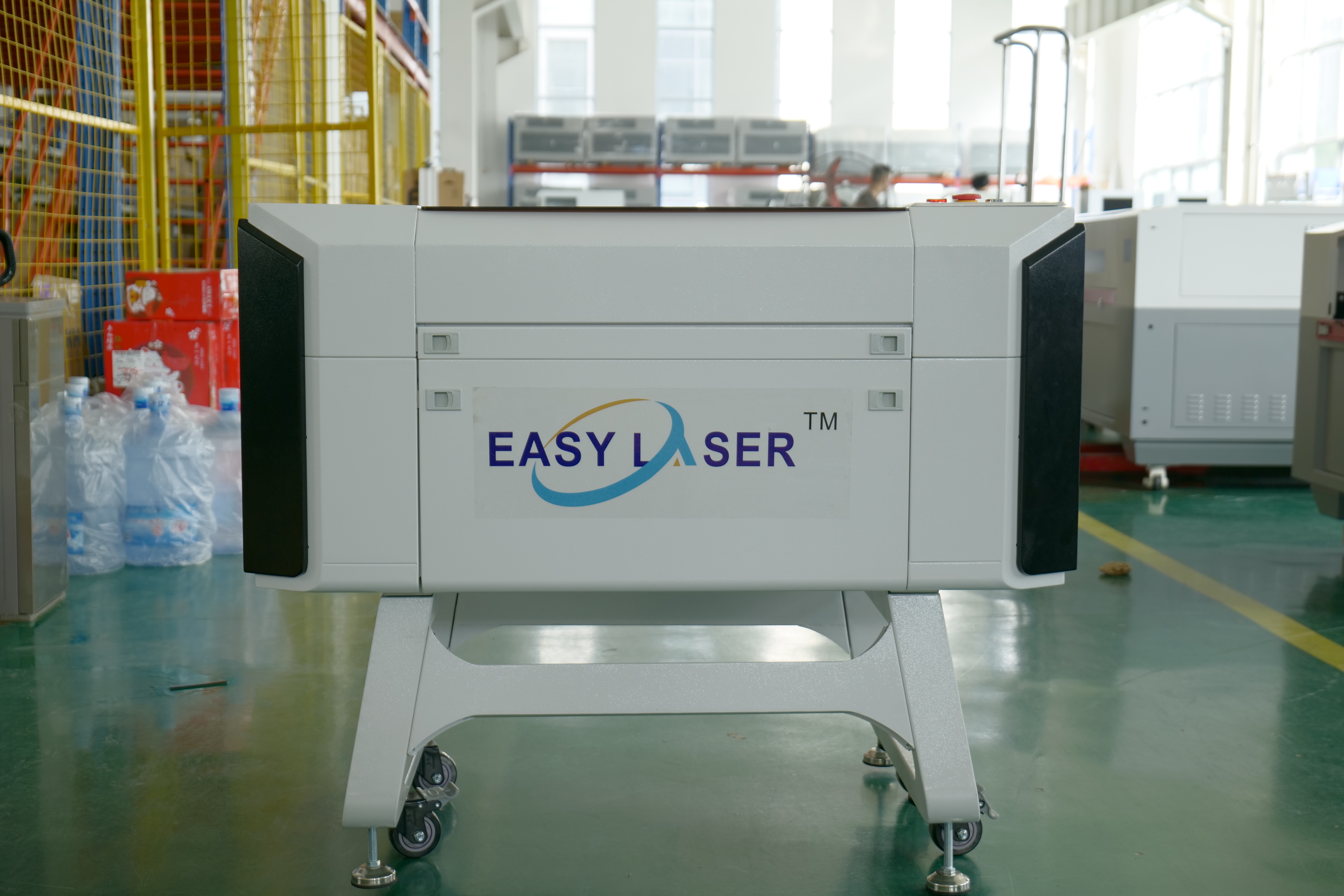
When processing organic materials, the type of laser source dictates the quality of the result. The CO2 leather cutter dominates the market because it operates at a wavelength of 10,600 nanometers (nm). This specific far-infrared wavelength is highly absorbed by organic compounds, including the collagen fibers that make up leather. High absorption means the laser energy instantly vaporizes the material rather than reflecting off it or passing through it.
CO2 systems offer a superior power-to-speed ratio. A standard 80W to 150W CO2 tube cleanly severs thick materials, such as 8oz to 12oz vegetable-tanned saddle leather, in a single fast pass. High processing speed reduces the dwell time. Dwell time is the amount of time the laser energy sits on one spot. Lower dwell time minimizes heat transfer into the surrounding leather. You get a cleaner edge with less carbonization and a smaller heat-affected zone.
Desktop diode lasers have gained popularity due to their compact size, but they present severe limitations for professional leather production. Diode lasers typically operate in the visible blue light spectrum around 450 nm. Leather does not absorb this wavelength as efficiently as the 10,600 nm CO2 wavelength. Diode lasers rely heavily on the color of the material. They struggle to cut light-colored or natural un-dyed leather because the light reflects off the surface instead of penetrating it.
Diode lasers generally output significantly less power, typically between 10W and 40W. This lack of power necessitates much slower processing speeds or multiple passes to cut through the material. Slower speeds lead to a larger Heat-Affected Zone (HAZ). This causes excessive edge burning, hardening of the leather, and severe warping. A diode might suffice for engraving logos or cutting very thin skived edges, but it cannot support reliable, high-throughput pattern production on a commercial scale.
The primary industrial alternative to laser cutting is a CNC flatbed cutter equipped with a drag knife or oscillating tangential blade. Comparing these technologies comes down to edge finish and machine maintenance.
A CNC blade cuts via mechanical shearing. This leaves a completely clean, raw edge with zero thermal damage. It is ideal for leathers that will not have their edges painted or burnished. Mechanical cutting requires robust material hold-down. Because leather is porous and often uneven, securing it to a CNC bed requires powerful, loud, and expensive vacuum pump systems. If the vacuum fails to hold the leather perfectly flat, the drag knife will pull and distort the pattern.
Lasers cut via thermal vaporization. This requires no vacuum hold-down for cutting forces. Hides are simply laid flat on a honeycomb or slat bed. The trade-off is maintenance. CNC machines require frequent blade replacements and mechanical lubrication. Lasers require optical alignment and regular cleaning of mirrors and focal lenses to maintain beam quality.
Feature | CO2 Laser Cutter | Diode Laser | CNC Oscillating Knife |
|---|---|---|---|
Cutting Mechanism | Thermal Vaporization (10,600nm) | Thermal Vaporization (450nm) | Mechanical Shearing |
Edge Finish | Sealed, slightly charred (requires cleaning) | Heavily charred, hardened edges | Clean, raw edge (no heat) |
Material Hold-Down | Minimal (Gravity/Light Vacuum) | Minimal (Gravity) | Heavy Industrial Vacuum Required |
Maintenance Focus | Optics cleaning, chiller maintenance | Lens cleaning | Blade replacement, vacuum filters |
Best Application | High-speed production, complex geometry, thick veg-tan | Hobbyist engraving, thin dark leathers | Mass production of chrome-tanned or synthetic leathers |
Selecting the right hardware specifications directly impacts daily operational efficiency. The bed size of the leather laser cutting machine must match your standard material dimensions. Leather is sold in irregular shapes like half-hides, double shoulders, bellies, or full hides. A machine with a small 600mm x 400mm bed requires operators to manually pre-cut large hides into smaller panels before they can be processed. This adds a labor step and increases material waste due to inefficient nesting.
For professional production, machines with bed sizes of 1300mm x 900mm or larger are preferred. Evaluating the utility of pass-through doors is also necessary. Pass-through doors allow operators to feed continuous rolls of material or oversized hides through the front and back of the machine. You can process sections sequentially without needing a machine bed large enough to hold the entire hide at once. This maximizes material yield and keeps the machine footprint manageable.
Thermal cutting generates smoke, soot, and localized flame. A robust air assist system uses a dedicated air compressor to blast a concentrated stream of air directly through the laser nozzle, hitting the exact point of vaporization. This high-pressure airflow extinguishes flare-ups instantly. It cools the cut edge to reduce the Heat-Affected Zone and forcefully clears smoke from the cut path to prevent soot from staining the grain side of the leather.
Optics selection dictates cut quality. The focal length of the lens determines the shape and depth of the laser beam's hourglass profile. A short focal length lens, such as a 2-inch lens, creates a very fine, concentrated spot size. This is ideal for high-resolution surface engraving and cutting thin leathers. For cutting thick 10oz belt blanks, a longer focal length lens, like a 4-inch lens, is required. The longer lens maintains a straighter beam profile over a greater distance. The cut edges remain perfectly vertical rather than sloped or tapered.
Vaporizing animal hide generates heavy organic particulate and strong, lingering odors. Relying on a standard bathroom-grade exhaust fan will quickly result in a smoke-filled workspace and damaged machine optics. Sizing inline exhaust fans correctly is mandatory. The fan must generate enough cubic feet per minute (CFM) of airflow to rapidly evacuate the cutting chamber before smoke can settle on the material or the gantry rails. A minimum of 1000 CFM is standard for a mid-sized bed.
If the production facility is located in a commercial space where venting thick smoke to the outside is structurally unfeasible or violates local zoning codes, specialized filtration is required. Evaluating multi-stage carbon filtration units becomes necessary. These standalone fume extractors pull the exhaust through HEPA filters to capture fine particulate. They use deep activated carbon beds to scrub the volatile organic compounds (VOCs) and odors from the air before recirculating it into the room.
The most common hurdle when adopting laser technology for leather is managing the thermal edge. Edge charring and a distinct campfire odor are inherent realities of the process. Dialing in parameters is the first line of defense. Operators balance higher speeds, lower output power, and sometimes multiple passes to find the sweet spot that cleanly severs the fibers without excessive carbonization. Too much power at slow speeds turns the edge into hard, brittle charcoal.
Post-processing workflows must adapt to handle the thermal edge. For vegetable-tanned leather, the residual soot can usually be wiped away with a damp cloth or a mild leather cleaner. Integrating edge burnishing with tragacanth gum or applying edge paint easily covers the darkened edge. For light-colored or easily stained leathers, operators use low-tack masking tape over the grain side before cutting. The tape absorbs all the smoke stains and vapor residue. You peel it away to reveal a perfectly clean surface.
Not all leather is safe to process with a laser. Identifying safe materials is a strict operational requirement. Vegetable-tanned, oil-tanned, and certain untreated aniline leathers are generally safe, producing only organic smoke. Understanding the hazards of chrome-tanned leather is critical for operator safety and machine longevity.
Chrome-tanned leather is processed using chromium salts. When subjected to the intense heat of a laser, these chemicals vaporize, potentially releasing toxic chromium compounds into the air. While high-end extraction systems mitigate some risk, many shops strictly prohibit lasering chrome-tanned hides. Even more dangerous are faux leathers and synthetic vinyls. Many artificial leathers are made from PVC (Polyvinyl Chloride). Lasering PVC emits highly corrosive chlorine gas and hydrochloric acid. This gas is lethal to operators and rapidly rusts and destroys the metal internals, linear rails, and electronic components of the laser machine within weeks. Total avoidance of PVC-based materials is mandatory.
Verify the tanning process of the leather with the tannery before cutting.
Never cut PVC or vinyl-based faux leathers under any circumstances.
Run exhaust systems at full capacity when cutting any organic material.
Consult material safety data sheets (MSDS) when sourcing synthetic leather alternatives like PU (Polyurethane).
Industrial laser systems require specific facility setups. Glass CO2 laser tubes generate significant heat and require active cooling. Industrial water chillers, such as CW-5000 or CW-5200 series units, must be integrated to circulate distilled water through the tube. This maintains a strict temperature range to prevent tube failure and ensure consistent power output during long production runs.
Establishing a strict maintenance schedule is non-negotiable. Vaporized organic resins from the leather inevitably coat the interior of the machine. Operators clean the mirrors and focal lenses daily using optical-grade wipes and solvent. Failure to clean the optics causes the laser beam to heat the resin buildup. This quickly cracks the lens or permanently damages the mirror coatings. Linear guide rails must also be wiped down and lubricated weekly to prevent soot buildup from binding the gantry system.
Request cut samples on your specific leather weights from manufacturers to evaluate edge quality and charring levels before purchasing a machine.
Calculate the total facility footprint required, ensuring adequate space for the machine, the industrial chiller, and the fume extraction system.
Verify that the machine's control software integrates smoothly with your existing vector design tools like Adobe Illustrator, AutoCAD, or LightBurn.
Establish a strict material testing protocol to ensure no PVC-based faux leathers or hazardous chrome-tanned hides are processed in your facility.
A: Yes, thermal cutting inherently leaves a charred edge on leather. You minimize this by optimizing laser speed and power settings, using high-pressure air assist, and applying masking tape. Post-processing techniques like edge burnishing, sanding, or edge painting easily remove or cover residual carbon.
A: A CO2 laser operates at 10,600 nm, a wavelength highly absorbed by leather, allowing for fast, clean cuts through thick hides. Diode lasers operate in the visible light spectrum, lack sufficient power for thick materials, and often cause excessive burning or fail to cut light-colored leathers.
A: It is generally not recommended. Lasering chrome-tanned leather vaporizes the chromium salts used in the tanning process, which can release toxic chemical compounds. Most professional shops restrict laser cutting to vegetable-tanned or oil-tanned leathers to ensure operator safety and maintain air quality.
A: Absolutely. One of the best hybrid workflows is using the laser to cut highly precise, durable physical templates out of acrylic, MDF, or plywood. These rigid templates can then be used at the workbench for manual cutting of materials that are unsafe to laser.
A: The campfire odor dissipates over time. You accelerate this by leaving the cut pieces in a well-ventilated area for 24 to 48 hours. Wiping the edges with a damp cloth, applying leather conditioner, or storing the pieces with baking soda packets also helps neutralize the smell.
A: A standard 80W to 100W CO2 laser easily cuts through 10oz to 12oz (4mm to 4.8mm) thick vegetable-tanned leather in a single pass. Higher wattage machines (150W+) cut even thicker saddle skirting faster, reducing the dwell time and minimizing edge char.
A: Masking tape is not strictly required, but it is highly recommended for light-colored, natural, or easily stained leathers. Applying a low-tack paper transfer tape to the grain side protects the surface from smoke damage and soot settling during the cutting process.


