
Please Choose Your Language
Views: 0 Author: Site Editor Publish Time: 2026-09-10 Origin: Site


In high-mix fabrication environments, floor space acts as a strictly constrained, revenue-generating asset. Every square foot dedicated to equipment storage subtracts directly from active production capacity. Transitioning to laser welding traditionally required accommodating bulky water-cooled systems. These legacy units mandate dedicated external chillers, complex plumbing networks, and large static safety enclosures that disrupt shop floor flow. Advancements in thermal management have made the Air Cooled Laser Welding Machine a highly viable alternative for industrial applications. Eliminating the chiller unit fundamentally alters equipment footprint, facility requirements, operator onboarding, and overall production capacity. This guide evaluates exactly how compact systems optimize workshop layouts, allowing fabricators to reclaim valuable square footage without sacrificing welding performance.
Traditional laser welders rely heavily on water chillers to maintain diode temperatures during operation. This creates a multi-component system demanding significant static floor space. A standard industrial water chiller adds substantial bulk, often mirroring the size of the laser power source itself. You must account for the physical dimensions of the chiller chassis and calculate the dead space required around it for proper ventilation.
Maintenance clearances consume valuable square footage. Technicians need physical access to the rear and sides of the unit to reach plumbing connections and coolant reservoirs. Routine maintenance requires space for coolant flushing, maneuvering buckets, and handling hoses. Deionization filters require regular replacement. Blocking access to these panels makes maintenance impossible. Water-cooled systems effectively become permanent fixtures. Once you route the plumbing and establish the footprint, moving the machine becomes a major logistical hurdle that disrupts ongoing shop operations.
Beyond the machine itself, the external hoses connecting the chiller to the laser source create a sprawling footprint. These thick lines carry distilled water and often sweat condensation in humid environments. They require protective cable trays or floor covers to prevent forklift damage, further eating into usable floor space and dictating where other equipment can be placed.
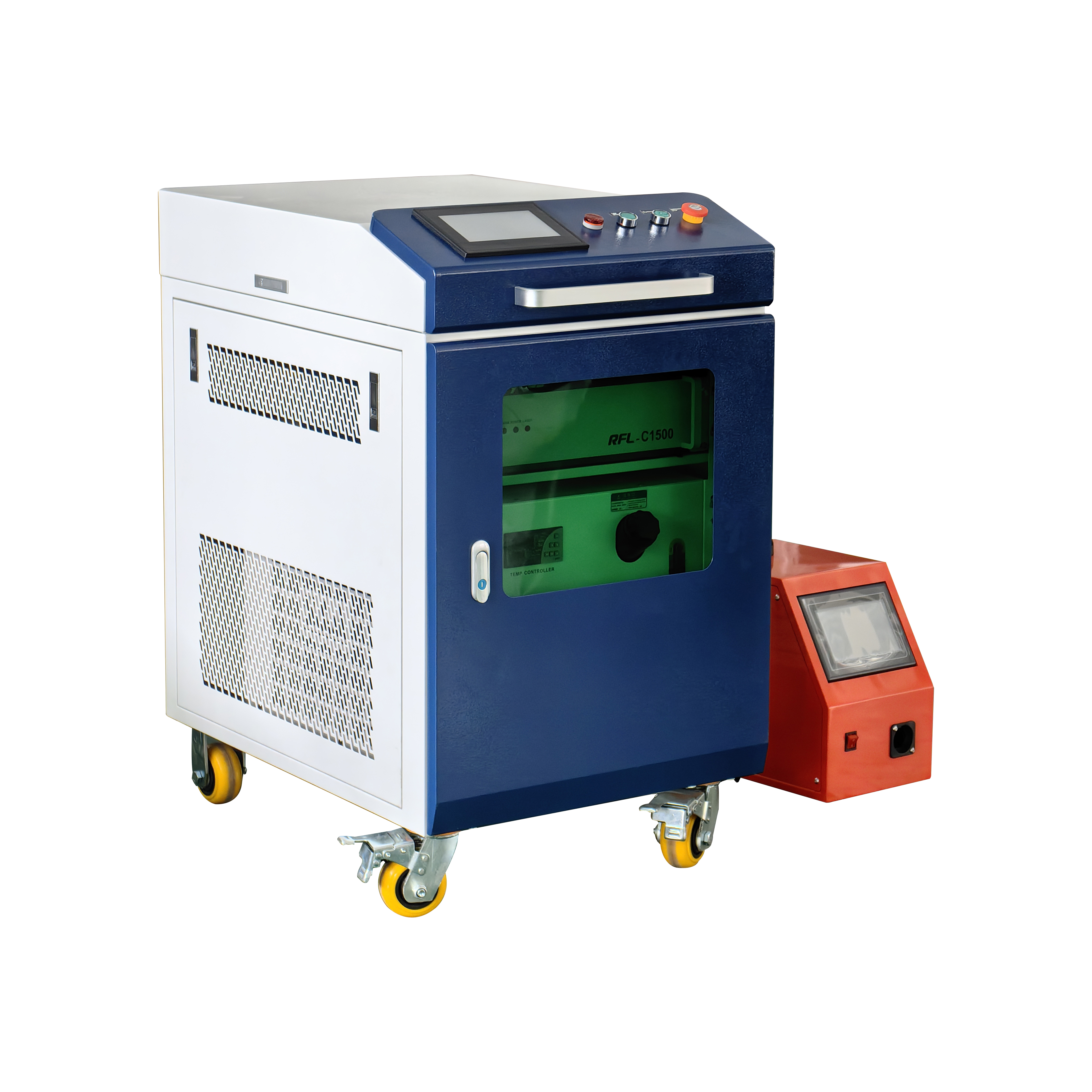
Air-cooling technology eliminates the need for liquid coolant entirely, drastically shrinking the equipment profile. Modern systems utilize phase-change cooling. They integrate advanced heat sinks directly into the chassis. Copper heat pipes draw thermal energy away from the laser diodes. A specialized refrigerant inside these pipes vaporizes upon heating, traveling to a cooler section of the pipe. High-RPM fans blow ambient air across dense metal fins, causing the vapor to condense back into a liquid. It then returns to the heat source via capillary action.
This closed-loop thermal management requires no water, pumps, or external reservoirs. Manufacturers consolidate the power source and laser generator into a single unit, building the thermal management system directly into the same compact chassis. This engineering approach removes the bulky external chiller and transforms a stationary industrial plant into a highly mobile tool. The absence of a water tank also removes hundreds of pounds of operating weight, allowing a single operator to push the unit across the shop floor with minimal effort.
Understanding the exact space savings requires looking at baseline dimensions. A traditional water-cooled setup often occupies a footprint of 1.5 by 2 meters, excluding operator space. A compact laser welding machine typically measures closer to 0.6 by 0.9 meters. The physical footprint drops dramatically, freeing up room for material staging or additional workstations.
Operational clearances also change. Air-cooled units require a minimum of 50 cm of clearance around the machine to ensure proper airflow for the intake and exhaust fans. Blocking this clearance causes thermal throttling, leading the machine to overheat and shut down. Water-cooled systems require larger clearances for technician access. Both systems require a baseline working zone. You must establish a minimum 2 by 2 meter area to allow safe operator movement and prevent the fiber optic cable from kinking or bending beyond its minimum radius.
| Specification | Traditional Water-Cooled System | Compact Air-Cooled System |
|---|---|---|
| Core Machine Footprint | Approx. 1.5m x 2.0m (Two units) | Approx. 0.6m x 0.9m (Single unit) |
| Operating Weight | 250 kg - 400 kg (with water) | 60 kg - 100 kg |
| Minimum Clearance | 1.0m rear/sides for plumbing access | 0.5m all sides for fan airflow |
| Mobility Status | Static / Permanent Fixture | Highly Mobile / Caster-mounted |
| Working Zone Required | 2m x 2m minimum | 2m x 2m minimum |
Shrinking the machine footprint changes workshop logistics by shifting the operational model from "part-to-tool" to "tool-to-part" manufacturing. Moving heavy, oversized fabrications across a shop floor wastes time and ties up overhead cranes and forklifts. A portable welding system mounts on heavy-duty casters, allowing operators to roll the laser directly to the workpiece.
This mobility allows shops to stow the unit when not in use. You can push the machine into a corner or under a mezzanine, reclaiming active floor space for other tasks. Compact units scale seamlessly. They serve as the primary welding station in small, independent workshops. In larger production spaces, they act as agile support units. Maintenance teams can roll them across the facility for immediate on-site repairs on large machinery without dismantling the broken components. This flexibility maximizes the utility of every square meter and reduces material handling bottlenecks.
Air cooling presents a specific trade-off: the machine exhausts heat directly into the shop environment. A high-powered laser generates significant thermal energy. The internal fans push this hot air out into the workspace to keep the diodes cool. In a large, open warehouse with high ceilings, this heat dissipates quickly. In a small, enclosed fabrication cell, the ambient temperature rises rapidly and can create an uncomfortable working environment.
You must evaluate your facility's ventilation capabilities. Specialized high-performance HVAC systems may be necessary if you operate in a confined room. Localized heat loads degrade machine performance over time. If the shop air exceeds 35°C (95°F), the air-cooling system loses efficiency because the temperature delta between the heat sink and the ambient air shrinks. You must implement cross-ventilation. Exhaust extraction fans placed near the machine help pull hot air out of the building, preventing the machine from drawing in its own heated exhaust and entering a thermal runaway state.
Eliminating the water chiller reduces the total electrical footprint of the welding station. Water-cooled systems require power for the laser source and a secondary circuit for the chiller's compressor. This often means dropping multiple high-amperage lines from the ceiling. Air-cooled units run entirely from a single power connection. They typically require less total amperage, simplifying electrical installations in older workshops that lack extensive power distribution panels.
Infrastructure reductions extend directly to the floor level. External chillers require thick coolant hoses running between the units. These hoses create severe trip hazards, clutter the workspace, and trap metal dust. A consolidated chassis eliminates these external lines entirely. Cable routing becomes streamlined. You only manage the main power cord, the grounding clamp, and the fiber optic torch cable. This clean setup is critical when operating in tight, confined spaces where operators must step around the equipment frequently.
Compact footprints do not negate safety regulations. Handheld lasers are Class 4 devices that pose severe risks to eyes and skin. Operating them in tight areas requires strict regulatory adherence. You must establish a minimum viable safety zone. The standard 2 by 2 meter working area is non-negotiable. This prevents accidental entry by unprotected personnel and gives the operator enough room to manipulate the torch without kinking the delivery fiber.
Mandatory warning labels must be highly visible on all approach vectors. Illuminated signage outside the welding zone is critical. A glowing warning light tied to the machine's interlock circuit indicates active laser emission. You must install light-tight barriers around the perimeter. Stray laser beams can reflect off shiny metal surfaces, and these reflections travel long distances with enough energy to cause permanent eye damage. Specialized glass windows are mandatory if you need visibility into the cell. This glass must be rated specifically for the laser's wavelength, typically 1070nm. Standard welding glass offers zero protection against fiber lasers.
Building a permanent steel enclosure defeats the purpose of a compact machine. Space-saving safety solutions are essential for maintaining an agile shop floor. Laser-safe welding curtains offer excellent flexibility. These heavy-duty curtains block 1070nm radiation and can be mounted on ceiling tracks or heavy-duty caster frames.
Retractable screens allow you to deploy the safety zone only when welding. When the job finishes, you fold the screens away, instantly opening up the shop floor for forklift traffic or material staging. Temporary enclosures work perfectly with mobile machines. Personal Protective Equipment (PPE) enforcement remains critical regardless of the enclosure type. Operators must wear laser safety glasses matched to the exact optical density (OD) requirements of the machine. Bystanders in close-proximity environments must also wear appropriate eye protection. Specialized welding helmets with integrated laser-safe lenses provide the highest level of operator safety, protecting against both the invisible laser radiation and the bright visible light of the weld pool.
Choosing an air cooled laser welder involves understanding its physical thermal limits. You must make an evidence-based comparison of duty cycles. Air cooling saves immense space, but it faces thermal throttling under extreme conditions. Continuous, heavy-duty automated welding generates relentless heat. Water chillers handle continuous 100% duty cycles on thick plate effortlessly. Air-cooled systems may require cooling breaks during prolonged, maximum-power operations to prevent diode degradation.
Define your ideal use cases before purchasing. These machines excel in sheet metal fabrication. They are perfect for high-mix, low-volume production environments where the operator frequently stops to reposition parts. Tight-tolerance manual welding on stainless steel, aluminum, and thin carbon steel is their primary strength. If your shop welds 10mm steel plate continuously for eight hours a day, a water-cooled system remains necessary. If you process 1mm to 4mm materials with frequent repositioning, air cooling provides more than enough thermal capacity while saving massive amounts of floor space.
Compact laser welders drastically reduce the operator learning curve. Traditional TIG welding requires months of dedicated practice to master foot pedal control, travel speed, and filler rod feeding. Laser welding simplifies this process entirely. The machine utilizes pre-set parameters for different materials and thicknesses, removing the guesswork from the setup phase.
Basic proficiency can often be achieved in under 10 minutes. The operator selects the material profile, pulls the trigger, and guides the torch along the joint. Wobble-head technology bridges small gaps automatically by oscillating the beam. This rapid onboarding eliminates the need for permanent training cells. You do not need to dedicate valuable floor space to long-term training bays. New hires can practice directly on scrap material in the active production zone, saving both time and spatial resources.
Reclaimed square footage holds direct financial value. You must calculate the Return on Investment (ROI) of this saved space to justify the equipment transition. Measure the footprint of your old welding setup, including the clearance zones. Subtract the footprint of the new compact unit. Multiply the saved square meters by your facility's lease cost per square meter to establish a baseline financial metric.
The true ROI comes from increased production capacity. Freeing up four square meters allows you to install an additional assembly station. It might provide the exact clearance needed for a new CNC press brake or a hardware insertion machine. Removing static equipment improves forklift traffic flow and reduces material handling times. Faster material handling translates directly to increased daily output. The space saved by eliminating the chiller generates revenue when repurposed for active manufacturing rather than static storage.
Deploying these machines in small spaces carries specific environmental risks. Overheating in unventilated shops is the primary concern. During peak summer months, ambient shop temperatures soar. If the shop air hits 38°C (100°F), the cooling fans blow hot air over the heat sinks, and the machine cannot shed thermal energy fast enough to protect the diodes.
Establish strict ambient temperature limits for the shop floor. Monitor the environment closely using digital thermometers near the welding station. Ensure adequate cross-ventilation by keeping bay doors open or running industrial floor fans. Install localized exhaust extraction hoods directly above the welding zone. This pulls the hot exhaust air up and out of the building before it recirculates. Do not push the machine into a tight corner where airflow is restricted. Maintain the mandatory 50 cm clearance on all sides to guarantee fresh air intake.
Working in tight spaces increases the risk of operator error. Navigating complex geometries with a handheld laser torch requires precision. Confined spaces force operators into awkward physical positions, increasing the chance of accidental trigger pulls or improper torch angles.
Implement specific training protocols for confined space welding. Emphasize torch control and strict cable management. The fiber optic cable contains a delicate glass core; stepping on it or bending it sharply around a table leg will destroy it. Instruct operators to appropriately reduce the welding speed in complex spaces. Slower travel speeds improve manual control, increase accuracy, and ensure consistent penetration. Proper torch angles prevent the beam from reflecting off the workpiece and damaging the torch optics. Clear the immediate area of any reflective tools or stainless steel tables that could cause dangerous specular reflections.
A: You must maintain a minimum clearance of 50 cm around the entire machine. This ensures unobstructed airflow for the intake and exhaust fans. Additionally, you must establish a 2 by 2 meter working zone to allow safe operator movement and prevent damage to the fiber optic cable.
A: Yes, they utilize advanced phase-change cooling and heat pipes to manage thermal loads. However, their continuous duty cycle depends heavily on ambient shop temperatures. They excel in sheet metal applications but may face thermal throttling during continuous, heavy-duty automated welding on thick plates.
A: These machines exhaust heat directly into the workspace. In small workshops, you need adequate cross-ventilation or localized exhaust extraction to remove this heat. Without proper ventilation, the ambient temperature will rise, causing the machine to draw in hot air and potentially overheat.
A: You must deploy modular laser-safe curtains or retractable screens that block 1070nm radiation. Install mandatory illuminated warning signage outside the work zone. Ensure all operators and bystanders wear wavelength-specific safety glasses and strictly enforce all Class 4 laser safety protocols.
A: The learning curve is exceptionally short. Thanks to intuitive controls, pre-set material parameters, and wobble-head technology, operators can often learn basic laser welding techniques in under 10 minutes. This rapid onboarding eliminates the need for dedicated, space-consuming training cells.
A: Peak wattage outputs can be identical between the two systems. However, thermal management dictates continuous performance. Water-cooled lasers sustain maximum power on thicker materials for longer durations. Air-cooled systems deliver the same peak power but are optimized for thinner materials and intermittent manual welding.


