
Please Choose Your Language
Views: 0 Author: Site Editor Publish Time: 2026-11-23 Origin: Site


Shop floors are crowded. Equipment budgets remain tight. Processing metals and organic materials traditionally demands separate devices. This creates a logistical bottleneck. It wastes both time and capital. In fast-paced industrial manufacturing, versatility is the ultimate competitive advantage.
Enter mixed CO2 laser technology. This revolutionary equipment bridges the gap. Manufacturers can streamline workflows. They can drastically reduce their machine footprint. Initial capital expenditures drop significantly. This guide explores the mechanics behind the technology. We cover practical maintenance strategies and specific applications. You will see why this asset is indispensable for mid-sized fabrication businesses.
Market analyses reveal a massive shift in custom fabrication. Global supply chains are localizing. B2B clients demand rapid, low-volume prototyping. Shops relying on siloed machinery frequently lose bids to agile competitors. The current industry trend favors hybrid manufacturing environments. Operational agility now outweighs sheer mass production capacity.
Modern designs frequently blend materials. Think of illuminated acrylic signage mounted on rigid carbon steel frames. Consolidating these diverse workflows onto a single machine bed is no longer just a luxury. It is a survival strategy. Businesses must future-proof their service offerings against unpredictable market demands.
To grasp the capabilities of this industrial equipment, look at the underlying physics. A standard CO2 laser operates at a wavelength of 10.6 micrometers. Organic materials like wood and plastic absorb this specific wavelength highly. This makes the laser incredibly efficient for cutting non-metals. Bare metals naturally reflect this wavelength. Standard CO2 lasers simply bounce off steel surfaces.
A mixed CO2 laser cutter solves this physical limitation. It uses a highly specialized beam delivery system. The core innovation lies in the dynamic cutting head. This component features a capacitive height-sensing mechanism. It detects microscopic variations on a metal sheet surface. Picture an operator feeding a slightly warped sheet of mild steel onto the honeycomb bed. As intense heat initiates the cut, the metal flexes. The capacitive sensor dynamically adjusts the Z-axis in milliseconds. It maintains a perfect focal distance instead of losing focus and creating a jagged edge.
Furthermore, the mixed head integrates a dual-gas assist system. The system utilizes standard compressed air for organic materials. This blows away smoke and prevents flare-ups. The moment the operator switches to metal, the system injects high-pressure oxygen through a specialized copper nozzle. Oxygen creates a rapid exothermic reaction with the heated metal. It essentially burns the steel away. The kinetic energy of the gas clears molten slag from the kerf. This seamless transition separates a true hybrid system from conventional single-purpose engraving machines.
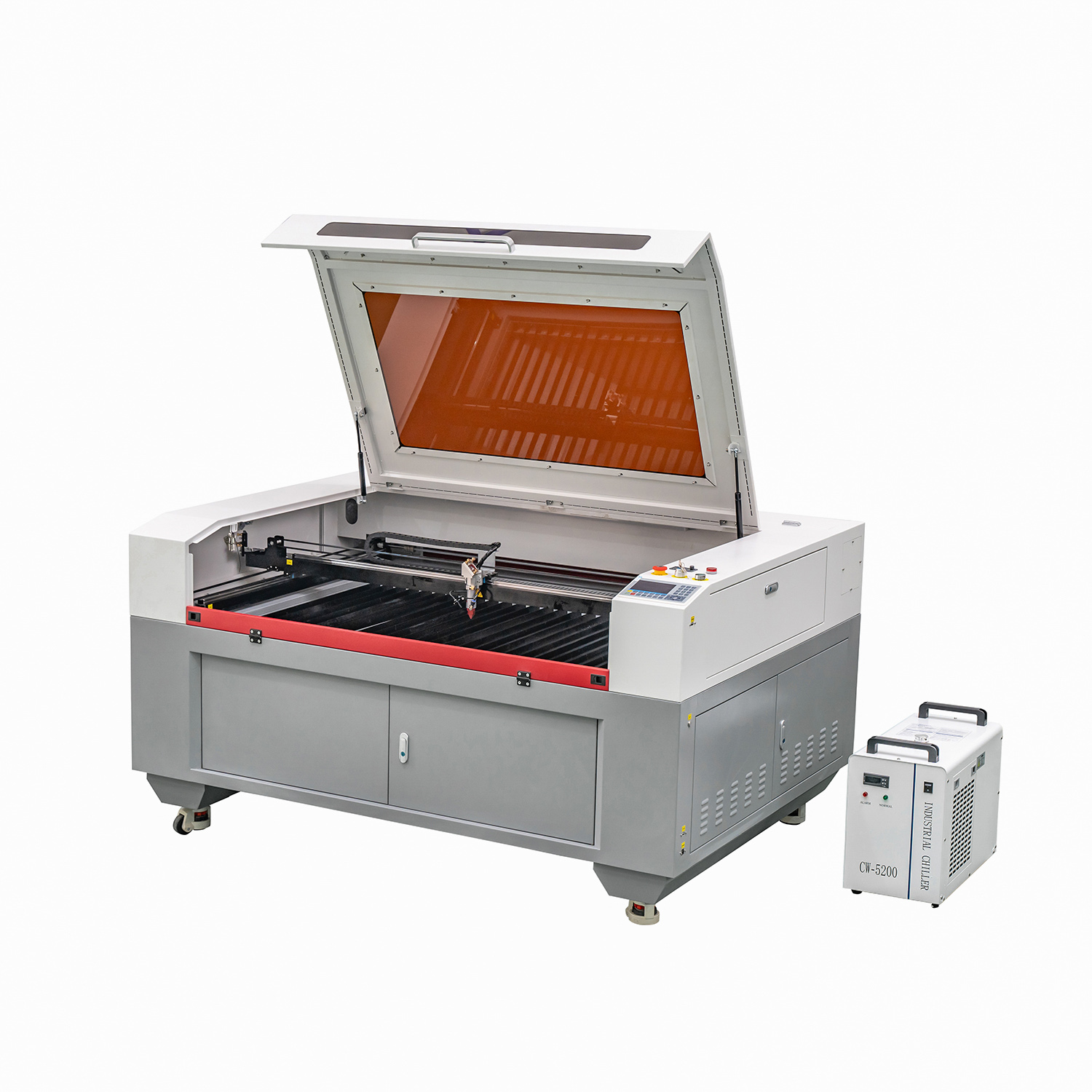
The unique ability to process diverse materials makes this equipment indispensable across several major industries. The signage and advertising sector is the most prominent adopter. Modern commercial signage frequently combines illuminated acrylic components with rigid metal structures. A sign maker can cut intricate flame-polished acrylic letters. They can immediately transition to slicing the 1.5mm carbon steel backing frames required to mount the sign. This is where metal and nonmetal laser cutting truly shines. It ensures perfect dimensional alignment between metal and plastic components without shifting materials between departments.
The personalized crafts and custom gift manufacturing industry also benefits heavily. High-end awards, bespoke furniture accents, and luxury packaging blend organic textures with metallic finishes. A manufacturer can engrave a highly detailed corporate logo onto a solid walnut base. They can subsequently cut a precision stainless steel inlay to fit flush within the engraved pocket. This mixed-media fabrication commands premium pricing in the retail market.
Architectural modeling represents another highly specialized application. Architects require precise scaled representations of their designs. They utilize MDF for structural massing, acrylic for glazing, and thin-gauge steel for structural trusses. The micro-precision of these machines fabricates intricate facades without compromising structural integrity.
Choosing the right configuration dictates your operational success. When evaluating a hybrid laser cutting machine, laser power and bed size are your primary metrics.
For compact workshops focusing heavily on leather, acrylic, and occasional thin metals, a 900x600mm format equipped with a 150W tube provides the perfect balance. It offers high detail resolution for engraving while packing enough punch to pierce 1.5mm carbon steel.
Conversely, high-throughput industrial environments require larger formats. A 1600x1000mm bed with dual laser heads maximizes production. Advanced models in this tier integrate CCD camera systems. The camera visually recognizes registration marks on UV-printed acrylic or sublimated textiles. The software then automatically compensates for material shrinkage or rotational misalignment.
Let us look at how mixed technology stacks up against traditional equipment:
| Feature | Standard CO2 Laser | Mixed CO2 Laser | Fiber Laser |
|---|---|---|---|
| Primary Material | Non-metals only | Non-metals & Thin Metals | Metals only |
| Metal Cutting Capacity | None | Up to 3mm Carbon Steel | Thick Industrial Plates |
| Floor Space Required | Low | Low to Medium | High |
| Capital Investment | $ | $$ | $$$$ |
Operating a dual-purpose machine introduces unique maintenance challenges. The system processes both vaporized organics and molten metals. The byproduct debris is highly varied. Implementing a strict empirical maintenance protocol protects equipment lifespan.
Cutting wood produces a sticky resinous smoke. Slicing steel ejects fine metallic dust. If resin coats the focal lens and metallic dust adheres to that sticky layer, disaster strikes. The laser beam will heat the debris rather than passing cleanly through the optic. This severe thermal shock cracks a zinc selenide focal lens in seconds. Operators must gently wipe the lens daily. Use optical-grade lens tissue and high-purity acetone in a single sweeping motion. This avoids scratching the delicate anti-reflective coating.
Inspect the copper cutting nozzle regularly. Molten slag can adhere to the nozzle tip. This interferes with the capacitive sensor electrical field. The auto-focus will miscalculate and crash the head into the material. Gently brush the nozzle with a soft wire brush between metal cutting sessions.
In addition, equip the compressed air system with an inline moisture and oil trap. Water vapor in the air line condenses on the focal lens. This instantly ruins the optics during an acrylic cut.
Investing in dual-purpose technology future-proofs your manufacturing capabilities. B2B clients expect rapid turnaround times for comprehensive multi-material prototypes. Suppose an advertising agency requests a retail display prototype incorporating a steel chassis and acrylic shelving. A shop equipped with a hybrid laser produces the entire assembly in-house within hours. Competitors relying on outsourced metal fabrication lose weeks to supply chain logistics.
Specifically, this technology acts as a gateway to market expansion. A traditional woodworking shop is entirely excluded from the lucrative custom metal fabrication market. Upgrading to a mixed-head system changes everything. That same shop can immediately bid on contracts for custom electrical enclosures, metal stencils, and architectural brackets. They do not need to hire a specialized CNC plasma operator.
The mixed CO2 laser cutting machine represents a pivotal shift for fabrication shops and creative design studios. Combining the precision of metal and organic material processing into one cohesive system unlocks unprecedented productivity. This versatility saves valuable floor space. It reduces operational costs. It empowers businesses to enter entirely new markets without purchasing superfluous machinery. Proper maintenance and a solid understanding of material parameters ensure long-lasting precision.
Are you ready to eliminate production bottlenecks? Assess your current material throughput today. Explore the specialized equipment lineup at EasyCNCLaser to find the exact wattage and bed size that fits your facility. Investing smartly in hybrid technology secures a strong, future-proof competitive advantage for your business.
No. Mixed CO2 lasers are primarily designed for thin metal sheets up to 3mm and non-metals. The 10.6 micrometer wavelength of a CO2 laser is highly reflective on metal surfaces. A massive amount of power is lost as heat. For heavy industrial metal plates exceeding 3mm, a Fiber Laser machine is strictly required. Fiber lasers operate at a 1.06 micrometer wavelength that metals absorb far more efficiently.
Modern machines make the switch relatively seamless. Physically, the operator swaps the cutting nozzle. You use a finer tip for metal and a wider tip for non-metals. On the software side, you select the appropriate material parameter library. This automatically toggles the gas assist solenoids from oxygen to compressed air. It also enables or disables the capacitive auto-focus tracking.
Generally, no. The machine uses a single high-power CO2 laser tube as its source. The innovation lies entirely in the delivery system and the cutting head. The specialized head manages beam delivery for both material types. It integrates the capacitive height sensor and dual-gas inlets into a single cohesive unit. This keeps the internal architecture streamlined.
Yes. These machines are highly effective at engraving non-metallic materials like wood, leather, glass, and stone. The system utilizes standard CNC motion control and a CO2 laser source. It performs high-speed raster engraving just like a traditional flatbed laser. However, CO2 lasers cannot engrave bare metals directly. They can only mark metals pre-treated with specialized laser marking sprays.
Safety protocols must be strictly enforced when processing diverse materials. Always ensure industrial exhaust systems are active to remove toxic fumes. When cutting metal, high-pressure oxygen is used. This creates a severe fire hazard if it interacts with flammable residues left over from wood cutting. The machine bed and crumb tray must be cleaned thoroughly between material swaps. Operators must wear appropriate Class 4 laser safety goggles rated for the 10,600nm wavelength.
The capacitive sensor relies on a clean electrical field to measure distance accurately. You must keep the ceramic ring and copper nozzle completely free of metallic slag and carbon buildup. Additionally, recalibrate the Z-axis capacitance periodically. This is especially important if the ambient temperature or humidity in your facility changes drastically.
While technically possible, it is highly impractical and not recommended. Upgrading requires replacing the motherboard, installing a heavy capacitive cutting head, adding dual gas solenoids, and upgrading the laser tube to at least 150W. The cost of parts and labor often exceeds the value of the old machine. Purchasing a dedicated hybrid system is far more cost-effective and reliable.


