
Please Choose Your Language
Views: 0 Author: Site Editor Publish Time: 2026-07-29 Origin: Site


The industrial transition from mechanical stamping and inkjet coding to high-speed laser marking has fundamentally changed how production lines handle organic and non-metal materials. Scaling production with these substrates introduces variable thermal responses that operators must manage carefully. Selecting the wrong laser specifications leads to excessive charring, inconsistent mark depths, ruined substrates, and severe production bottlenecks. You cannot force a one-size-fits-all laser onto materials that burn, melt, or vaporize at different temperatures.
This technical framework breaks down how to evaluate and specify a CO2 Laser Marking Machine based on material thermal dynamics, throughput requirements, and facility integration realities. We will look at the exact parameters needed to process organic materials efficiently, the hardware configurations that prevent line stoppages, and the facility upgrades required to handle the byproducts of laser ablation safely.
Wavelength Specificity: The 10.6 µm wavelength of CO2 lasers is strictly required for high-contrast nonmetal laser marking, as organic materials absorb this frequency optimally compared to Fiber or Nd:YAG systems.
Tube Technology Dictates Viability: The choice between DC glass tubes and RF metal tubes directly impacts beam quality, marking speed, and long-term maintenance costs.
Material Variability: Wood, bamboo, leather, and paper require distinct parameter configurations (speed, power, frequency) and pre-treatment techniques to mitigate edge charring and prevent substrate burn-through.
Multi-Application Versatility: Modern industrial CO2 systems are capable of transitioning between surface marking, deep engraving, and ultra-thin profile cutting on flexible substrates.
Facility Readiness: High-volume CO2 laser marking on organic materials necessitates industrial-grade fume extraction and thermal mitigation systems to maintain safety and compliance.
Organic materials possess cellular structures that react to specific light spectrums. The 10.6 µm wavelength emitted by a CO2 laser is highly absorbed by organic compounds. This specific infrared spectrum vaporizes the material cleanly rather than melting or shattering it. When the laser energy hits the surface, it causes rapid localized heating, turning the solid material directly into gas. This clean ablation process allows operators to achieve sharp, high-contrast marks on non-metals without leaving jagged edges or excessive slag.
Fiber lasers operate at a wavelength of 1.064 µm. This shorter wavelength passes right through most transparent or organic materials or causes uncontrolled burning. If you point a fiber laser at a piece of pine, it will either do nothing or start a fire without leaving a legible mark. Therefore, CO2 technology remains the exclusive industrial choice for wood, leather, paper, glass, bamboo, rubber, and specific packaging plastics. You cannot substitute a fiber system for these applications, regardless of the wattage.
Understanding the operational boundaries between different processes dictates how you set up the machine. Surface marking involves a color change without significant material removal, often achieved at higher speeds and lower power. Deep engraving removes material to create a tactile depth, requiring higher power, slower speeds, and multiple passes. Clean vector cutting completely severs the material, demanding precise focal control, high power, and heavy air assist to blow molten material out of the kerf.
When setting up a production run, operators must define whether they are marking, engraving, or cutting before touching the control software. A setup designed for surface marking will fail to engrave deeply, and an engraving setup will burn right through thin substrates if not adjusted. The physics of the 10.6 µm wavelength provide the capability, but the operator's control over power and speed determines the outcome.
Different organic materials require tailored approaches to achieve acceptable results on the floor. wood leather laser marking presents distinct challenges due to density variations, moisture content, and thermal sensitivities.
Wood and bamboo have highly variable grain densities. Latewood is denser than earlywood, and natural bamboo features hard nodes that resist ablation. These variations mean the laser will engrave deeper into softer areas and shallower into harder areas if parameters remain static. Operators must adjust power and speed to achieve uniform engraving depth. For example, processing 3mm birch plywood requires different settings than marking solid oak. You often need to run a slightly defocused beam or increase the speed to prevent excessive charring while maintaining contrast.
Leather marking requires strict thermal management. Genuine leather reacts differently than synthetic leather. High-contrast marks on full-grain cowhide can be achieved with moderate power and speed, resulting in a clean, debossed look. However, processing PVC-based synthetic leathers releases hazardous chlorine gas, which destroys machine optics and poses severe health risks. Operators must verify the chemical composition of synthetic leathers before processing. For safe synthetics like polyurethane (PU), parameters must be tuned to prevent excessive edge melting, usually by increasing speed and lowering power.
Paper, cardboard, and packaging foils demand high-speed, low-power marking to prevent burn-through. When marking serial numbers or expiration dates on corrugated cardboard at 120 meters per minute, focal precision and pulse frequency are critical. The goal is surface-level bleaching or ablation. You want to remove the top layer of ink or slightly scorch the paper fibers without compromising the structural integrity of the packaging material or penetrating barrier foils.
Surface treatments drastically alter required parameters. Varnishes on wood, dyes on leather, or clay coatings on paper change how the laser energy is absorbed. A heavy clear coat on wood might require a slower pass to penetrate the finish before marking the wood beneath. Application techniques, such as applying standard masking tape over wood or leather before engraving, eliminate soot deposits and halo burn marks. The laser burns through the tape and the material, and the operator simply peels the tape away to reveal a perfectly clean edge.
Reference Parameter Matrix (Factory-Tested Baselines) | ||||
Material | Process | Estimated Power (%) | Estimated Speed (mm/s) | Frequency (kHz) |
|---|---|---|---|---|
Softwood (Pine/Cedar) | Deep Engraving | 35 - 45 | 300 - 400 | 20 - 30 |
Hardwood (Oak/Walnut) | Deep Engraving | 60 - 75 | 200 - 300 | 20 - 30 |
Genuine Leather | Surface Marking | 15 - 25 | 500 - 700 | 30 - 40 |
Corrugated Cardboard | High-Speed Coding | 10 - 20 | 800 - 1200 | 40 - 60 |
Coated Paper | Ablation/Bleaching | 10 - 15 | 1000 - 1500 | 50 - 60 |
3mm Birch Plywood | Vector Cutting | 80 - 90 | 15 - 25 | 10 - 20 |
These baselines provide a starting point. Operators must run test grids on scrap material from the actual production batch to dial in the exact settings. Variations in ambient humidity, material moisture content, and ambient temperature will shift these optimal parameters slightly from day to day.
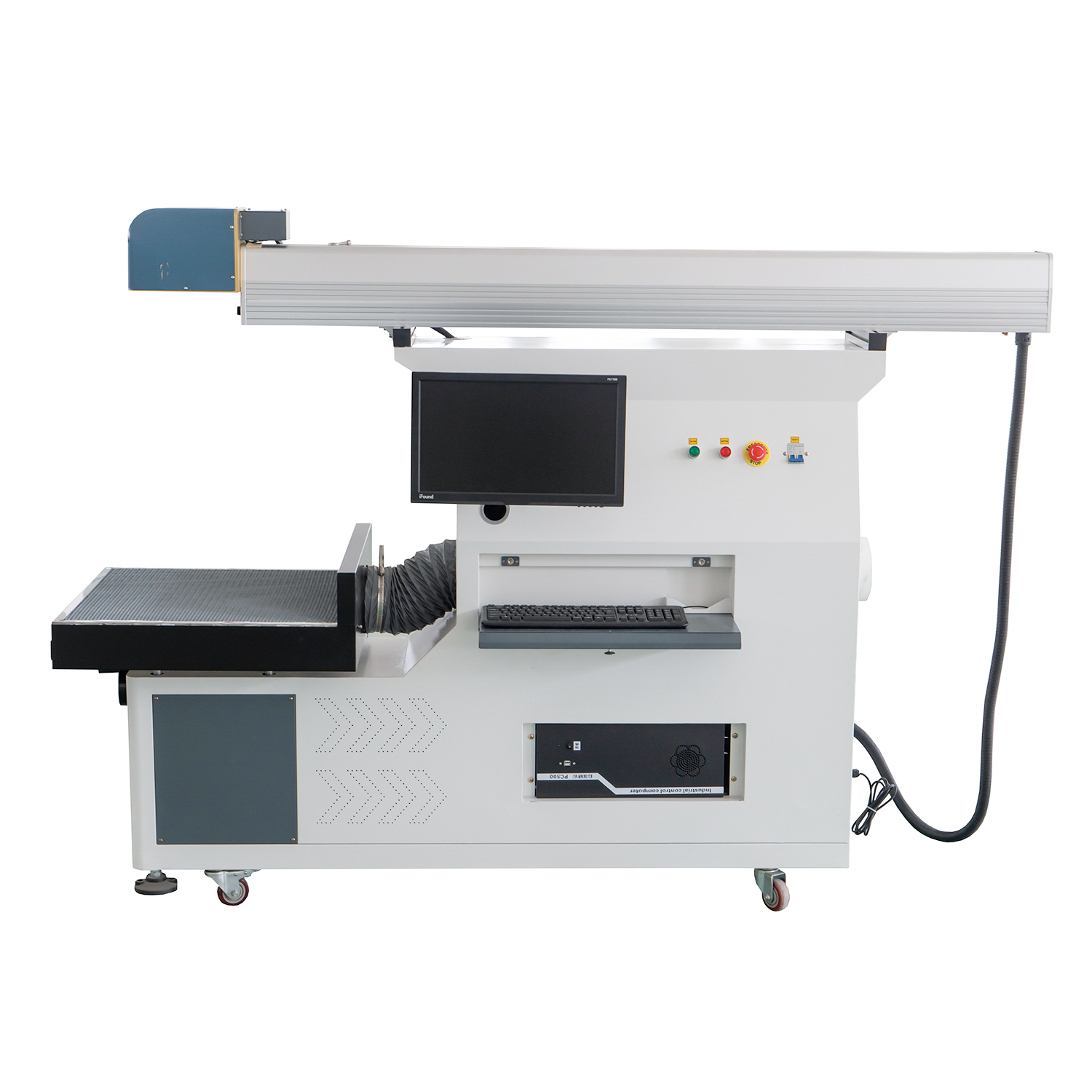
Selecting the right hardware specifications ensures the machine meets actual production demands rather than just looking good on a spec sheet. Power output directly influences marking speed and depth capabilities. A 30W system handles surface marking and light engraving on paper and thin leather. A 60W or 100W+ system allows for faster line speeds in continuous production and deeper engraving on hardwoods. However, higher wattage requires tighter thermal control. Pumping 100W into dry cardboard at slow speeds will ignite the material instantly.
Beam delivery systems dictate throughput capabilities and integration methods. Incremental Galvanometer (Galvo) systems use moving mirrors to direct the beam rapidly across a stationary marking field. Galvo heads are mandatory for high-speed, repetitive marking, date coding, and serializing on moving conveyor lines. They move the beam at thousands of millimeters per second. Gantry (Flying Optics) systems use X-Y plotters to move the actual laser head over the material. Gantry systems are better suited for large-format cutting and engraving across wide sheets of plywood or leather hides, but they are far too slow for high-throughput packaging lines.
The laser source is the engine of the machine. RF (Radio Frequency) metal tubes offer faster pulse rates, smaller spot sizes, and rapid modulation speeds. They can turn on and off thousands of times per second, making them ideal for continuous industrial marking and high-resolution photo engraving. RF tubes also boast operational lifespans exceeding 20,000 hours before requiring a gas refill. DC (Direct Current) glass tubes have a lower initial capital expenditure but require frequent replacement, usually every 2,000 to 4,000 hours. They are fragile, water-cooled, and have slower modulation speeds, which limits their effectiveness in high-speed Galvo setups.
Optics and focal length determine the marking area and precision. A larger marking area requires a longer focal length lens. This increases the minimum spot size and reduces energy density, which affects the depth and clarity of the mark. If you need to mark a 300mm x 300mm area, you need a longer lens than if you are marking a 100mm x 100mm area. Operators must balance the required field size with the necessary spot resolution. You cannot get a microscopic spot size over a massive marking field with standard optics.
Cooling systems also play a role in continuous operation. RF tubes are typically air-cooled at lower wattages but require dedicated water chillers at 100W and above. DC glass tubes always require water cooling. An undersized chiller will cause the laser power to fluctuate as the tube heats up, leading to inconsistent mark depths across a long production run. Always specify a chiller with a cooling capacity that exceeds the laser tube's thermal output.
Integrating a CO2 laser system into a facility requires addressing specific operational risks and upgrading infrastructure. Vaporized organic materials produce volatile organic compounds (VOCs), heavy smoke, fine particulate dust, and strong odors. Industrial-grade fume extraction is mandatory. Venting out a window is not an industrial solution. Multi-stage HEPA and activated carbon filtration systems must be integrated directly with the laser enclosure to protect operators and maintain a clean working environment. Failure to extract fumes properly will coat the laser optics in sticky resin, destroying the lenses in a matter of days.
Fire suppression and thermal mitigation are critical when processing combustible materials. Applying high-energy lasers to paper, cardboard, and dry wood carries inherent fire risks. Continuous air assist is necessary to blow away combustible gases and cool the material during processing. The air assist nozzle directs compressed air directly at the focal point. Facilities should also implement flame detectors inside the enclosure and automated gas shut-offs to ensure safety. Operators must never leave a laser cutting wood or cardboard unattended.
Workflow automation enhances efficiency and reduces operator error. Evaluate the machine's control software compatibility with existing ERP or MES systems. Seamless integration allows for dynamic data marking, such as barcodes, QR codes, serial numbers, and batch codes. Instead of an operator manually typing in today's date code, the software pulls the data directly from the central server, reducing manual entry errors and streamlining production tracking across the facility.
Electrical requirements must be verified before installation. Industrial CO2 lasers, especially those with heavy-duty chillers and extraction units, draw significant amperage. Ensure the facility has dedicated circuits with clean power. Voltage fluctuations will cause the laser output to spike or drop, ruining the material. Installing a power conditioner or uninterruptible power supply (UPS) protects the sensitive control electronics from factory floor power surges.
Selecting a vendor goes beyond reading the machine specifications. You must evaluate vendor support and Service Level Agreements (SLAs). Critical support metrics include guaranteed uptime, replacement parts availability, and on-site calibration services. If an RF tube fails, you need to know if the vendor stocks replacements domestically or if you will wait weeks for international shipping. Reliable support minimizes production downtime and keeps the line moving.
Application testing is the most crucial step before procurement. Mandate vendor-provided sample testing on your exact proprietary materials. Do not rely on generic material tests. Send the vendor your specific coated cardboard, your exact batch of leather, or your specific plywood. This verifies cycle times, edge charring levels, and overall mark quality. Slight variations in material composition significantly impact laser performance.
When reviewing the test samples, inspect the edges under magnification. Look for excessive melting on synthetics or heavy soot deposits on wood. Ask the vendor for a detailed report of the exact parameters used to achieve the sample mark. If they had to run the machine at 100% power and incredibly slow speeds to get a decent mark, the machine is underpowered for your application. You want a machine that achieves the desired result while running at 60% to 80% capacity, leaving room for adjustments and reducing wear on the tube.
Consider the software ecosystem provided by the vendor. The hardware might be robust, but if the control software is outdated, buggy, or lacks integration capabilities, the machine will become a bottleneck. Request a software demonstration to see how easily an operator can import vector files, set up dynamic text fields, and adjust laser parameters on the fly.
Audit your current production line speeds to determine the exact cycle time the laser must meet.
Gather physical samples of every material variant you intend to process, including different coatings and thicknesses.
Define the required mark depth and contrast acceptable for your quality control standards.
Request a formalized proof-of-concept from shortlisted manufacturers using your specific materials and required cycle times.
Verify the facility's electrical capacity and ventilation infrastructure before finalizing the machine specifications.
A: CO2 lasers operate at a 10.6 µm wavelength, which is absorbed by organic materials like wood, leather, and paper, allowing for clean vaporization. Fiber lasers operate at 1.064 µm, which passes through or burns organic materials uncontrollably, making them suitable only for metals and certain hard plastics.
A: Yes, a 30W CO2 laser can engrave hardwood, but it operates at slower speeds compared to higher wattage systems. Multiple passes are often required to achieve deep engraving, and operators must manage thermal buildup to prevent excessive charring on the wood surface.
A: RF metal tubes provide faster pulse rates, smaller spot sizes, and rapid modulation speeds. This allows for the precise marking required in high-speed industrial environments. They also feature a significantly longer operational lifespan and better beam stability than DC glass tubes.
A: Processing paper and cardboard presents a high fire risk. Safety requirements include continuous air assist to remove combustible gases from the cutting zone, integrated flame detectors, automated shut-offs, and robust fume extraction systems to handle heavy smoke and particulates.
A: A longer focal length lens increases the marking area but also increases the minimum spot size, which reduces the energy density at the material surface. A shorter focal length provides a smaller, more intense spot for finer details but restricts the overall marking field size.
A: Applying a layer of standard masking tape over the material surface before marking protects the surrounding area from soot and halo burn marks. Proper use of compressed air assist also blows away vaporized debris and cools the edges during the ablation process.


